Wednesday, April 25, 2012

Top 10 Avacyn Restored Cards for Limited: AVR Meat and Potatoes


Welcome back to another edition of Meat and Potatoes, Avacyn Restored edition!  This coming Saturday is the Prerelease, and this time, we get a special treat.  Normally, we only have one Prerelease a year with only one set (save the summer Prereleases of Core editions of late), but this year we get two!  I like homogenous Prereleases because they allow more consistent and intentional strategies.  Although I had a fine finish last time, I hope my blitz of Limited practice since then will have honed my skills to take the cake.

Avacyn Restored is fairly separate from the block in terms of mechanics; no Werewolves or flip cards, no Flashback and no Morbid.  That’s because the angels under Avacyn have been, uh, restored.  I kind of like that break from a block; Rise of the Eldrazi did the same thing.  No landfall or kicker in there, if I recall; just monstrous Cthulhu beasts.

The spoiler came out Monday and, either despite or because a flush of illness, I was able to sit down and read the spoiler in its entirety.  The powerful cards that were spoiled early seemed to have fairly specific purposes; the multi-colored cards and massive mythics were all very expensive and splashy.  Many players believe this is just how mythics should be, and the “best” cards should be rare so they’re easier, but not cake, to get.  That’s the second time I’ve said cake…I must be hungry.

The set looks like it’s going to give players of all brands something to play with; EDH and Multiplayer/Variant lovers, tournament-cramming Spikes, and a strong Limited game.  Limited, as it is of the most interest to me, will be our first stop.

As we look over the set of all 240-some-odd cards that were spoiled Monday, let’s look and see what stands out as true Meat and Potato cards for limited.  As a reminder, Meat and Potatoes cards are the basic, run-of-the-mill stuff that you’re bound to see in a large portion of every Sealed tournament or booster draft in which you participate; this leaves out rares and mythic rares, for the most part.  In Limited, the commons and uncommons rule and change the game.  That’s why my Cube only consists of those cards!

It was hard to cut down my Top Ten to just that many, so we’ll begin with an honorable mention.

HM) Abundant Growth

These vines just splash all over!
This little gem of an enchantment is a wonderful option for Limited mana fixing.  It solves a lot of problems otherwise created by traditional ramp and color fixing.  First, it provides benefit immediately (if needed), unlike Rampant Growth, Birds of Paradise, Terramorphic Expanse, etc.  Those cards are great, but they often lack relevance late in the game, which is when you’re ripping for that answer or final few points of damage.  This one is useful in an opening hand that otherwise might be unkeepable AND as a late-game topdeck.  Thirdly, if you just need a fix and you don’t know what you need yet, this will relieve your woes.  This is especially relevant in Sealed when you just about have to play two colors and a splash (or two splashes, ugh).  I know I’ve stared at a Terramorphic Expanse first turn and I wasn’t sure what land I’d need because of my awkwardly color-heavy hand.  This solves that problem.  Fix without the mess, and it cantrips; that extra card really seals the deal.  Seems pretty good.  As a sidenote, I want to think this is Utopia Sprawl, but it is not, and remember that, too!

Now…

10) Angel’s Tomb

Pretty art.  Zero humor.
A 3/3 flyer for 3 colorless mana is outstanding, but desperately unlikely (though you can get a 3/2 flyer for 1 in Standard right now; still trying to figure that one out.)  However, Angel’s Tomb fills a role in Limited that reminds me of Halcyon Glaze, a legit 1UU Enchantment from Ravnica that turned into a 4/4 flying Illusion instead.  This is pretty flexible, being colorless and all, and with all the ways to blink a creature in and out, flashing a creature in, or through tokens, this will be active a fair amount of the time, making it a slightly conditional, but still solid addition to most any deck.  You won’t want to first pick it in Draft, but it seems like solid 4th or 5th pick material, and it will be an inclusion in most any creature heavy deck in Sealed.

9) Driver of the Dead

Driving Miss Zombie.
This is an interesting card to me due to its specificity (as opposed to the normally lauded flexibility of my choices,) but I think that the card advantage as well as soulbond opportunities afford it a slot on the list.  He’s a big enough body too that he chump-blocks well and you still get value.  There are certainly other better 4 drops, but he goes well in an aggressive deck or a defensive deck all the same.  He should make it around fairly late in Draft, as there are only certain decks that will get to take advantage of him.  Get back a utility creature, an undying creature, or something else.  Strangely enough, I think this guy’s best fit is in R/B aggro or B/G.

8) Pillar of Flame


Woah, a Sorcery Shock.  With an exile clause.

Groundbreaking.
You might think this is weak, but as I surveyed the set, I’ve found very little unconditional spot removal outside of rares and mythics.  White/Red might actually catch a break this time around.  There are enough aggressively costed Humans in these colors to constitute an early guess at a Limited archetype.  Maybe this is just my bias talking, but I just feel bad for these enemy colors that couldn’t effectively suit up in either ISDx3 or DKA/ISD/ISD.  Maybe they’ll get a shot, and it’s little things like this that will help.  It also gets rid of undying creatures before they have a chance to undie, and provides desperately needed non-combat interaction for aggro decks.

7) Ghostly Flicker

*Blink blink*
I had a whole deck for a while built around the blue/white blinking creatures of Shadowmoor Block (Mistmeadow Witch + Mulldrifter, etc.)  It was one of my favorite decks to play and, for my opponents, one of the more frustrating decks to fight.  Momentary Blink with an upgrade in flexibility, the versatility of this spell is boundless in Limited.  Untap two creatures after your opponent attacks, wipe away an enchantment or prevent spell/lethal damage, reset ETB effects or undying counters, choose new targets for a paired creature, untap a land if you need that color of mana (very badly) or to use its effect again in the case of the enemy-colored ability lands, or any number of niche roles.  I’m sure I’m forgetting something, but this is a great trick for any of the above roles, as well as those I’m missing.  Blinking was always so undervalued in my opinion, and Momentary Blink is continually one of my favorite cards to facilitate this.  It also only requires the one color. 

6) Nearheath Pilgrim

Lifelink really tips things in your favor.
The only white card on this list (as most of the best cards I’ve seen in White are rare or mythic), Nearheath Pilgrim seems to be a really good card that requires a pinch of work to extract the most value.  In the early game, he can provide a little edge in a race by giving you a few points of life, forcing your opponent to stay on defense while you develop your board.  In the late game, your largest creatures can get lifelink and bring you back from the brink or secure your place in the lead.  Not too much else to say about him.  He obviously feels like Alabaster Mage, but I think he provides a little more efficiency while requiring a little more skill to play.

5) Wolfir Avenger

Khaaaaaaa....roooooo!
One of the more exciting cards I found (my fondness for Green notwithstanding), this guy might even see a hint of Constructed play in Core Green decks when Thrun rolls out.  A flashable Trained Armadon that regenerates?  That seems pretty great in Limited and it fills a powerful role on both offense and defense.  The only disadvantage is his mana commitment; two-color decks shouldn’t have a problem, but three-color brews might want to steer clear; he’s best when you can reliably cast him at the end of your opponent’s third or fourth turn or mid-combat on those turns.  Also, I don’t know if this will make sense, but he just looks like he’d be good.  This is a skill I’ve had a lot of trouble developing.  Consider Dark Confidant.  I thought he was pretty terrible when he came out six years ago.  Now, as a forty or fifty-dollar card and having played with one, I’ve realized my mistake.  Wolfir Avenger looks good.  Maybe it just reminds me of Troll Ascetic or something. 

4) Maalfeld Twins

Maalfeld better if he was a bit cheaper...
This guy feels suspiciously like Grave Titan’s anemic brother.  Nevertheless, a strong 4/4 body with a Moan of the Unhallowed on the tail end seems excellent in an aggressive deck’s top-end.  On defense, it also provides three turns worth of chump blockers on the floor to dissuade attacks from your opponent’s monster ground pounder.  Zombie synergies abound, and he could even find some weird place in a low-tier Constructed Zombie deck.  As I wish for the Titans’ demise at the end of September this year, I hope there will be more room for these conservative monsters to get their chance to shine.  If he was just one mana cheaper, he might be first on this list.

3)  Mist Raven

Oops, you mist your blocks.
Mist Raven is built on a classic template; a simple and effective mechanic with tons of applications and this time, we get an evasive creature, all for the low, low price of four mana!  I’m not sure if you should first pick this, but in a weak pack with a whiff of a rare, I might.  Blue looks pretty strong in the format, both in Sealed and Draft.  Aether Adepts and, previously, Man O’ Wars have always been strong choices for their tempo-swinging, two-for-oneish feel.  Load up on as many of these on the four slot as your deck will hold and you’ll probably sweep your flight/pod. 

2) Zealous Conscripts

Yankee doodle came to town, riding on a po...OH CRAP WHERE'S THE PONY?!?!
Act of Treason on a stick!  A fairly solid stick, too.  Most of the time, the 3/3 for 4X cards in any given set are mediocre filler cards (see Venser’s Sliver, Scourge Servant, or Tuktuk Grunts).  Now, these Conscripts know how to turn a game around.  Has your opponent stabilized at 10 life while they bludgeon you to death with some monstrous Angel, or are you having trouble breaking through with a clumsy board state?  Have no fear, steal their biggest guy and bash them right back!  The fact that you can target any permanent gives this even more flexibility; remove control of some oppressive enchantment, land or planeswalker and bend it as you need.  Although it is a rare and not completely unconditional, it IS a gamebreaker, and those are the cards I like to have when I shuffle up 40.

1) Into the Void

Void where prohibited.
Arguably the most textually boring card that may ever get to #1, this card is vicious and utterly unfair.  Whiplash Trap busted so many games open in a grid-locked board that is the definition of value.  This is an excellent choice against aggressive decks as well as powerfully defensive decks, giving you the time to recover or the window to attack.  Unsummon and its variants have always been a fine choice.  The fact that this hits two creatures should always play on your mind; break paired creatures, erase tokens, remove their entire defense, activate the “one creature matters” clauses for your own creature.  There is a lot of power in this card.  Even if it doesn’t kill the creatures, they will need to spend two turns recasting them most likely, and you’ll have two turns to recover or develop.  It’s easily splashable and in a format without tons of removal, this can be exactly the piece you need for your X/U aggro puzzle.  I don’t feel great about this making the top seat, but I’m not sure what else would.  In Dark Ascension, it was Tragic Slip (though I might amend that to Lingering Souls now).  You WILL get a groan for your opponent as Into the Void resolves.

There are two new mechanics in this set of which a lot has been written and discussed.  The first, “soulbond,” is a mechanic affiliated with certain creatures.  When the creature with soulbond or any another creature comes into play, you may pair these two creatures, so long as both are otherwise unpaired.  When paired, both of those creatures receive a certain bonus.  I really like this mechanic.  Granted, it is only a Limited mechanic with few to no Constructed applications, where each card needs to be fairly self-reliant.  Still, it will offer some interesting reactions within the game as well as some interesting drafting.  You won’t want just creatures with soulbond, as they can only bond to one creature at a time, so you’ll need to balance bonding and unbonding creatures.  I have no idea what that balance should be – eight bonding to eight unbonding?  I’m not sure.  It will take a fair amount of playtesting to see how many is too many.

Next, the “miracle” mechanic allows you to cast some nonpermanent spells immediately as you draw them, so long as it’s the first card you draw that turn, drastically reducing the cost and allowing you to play sorceries with miracle during your draw step.  I’m really not sure how I feel about this; it’s begging to be broken, especially in Constructed.  It adds a certain level of luck to a game where good players try to minimize luck’s role in the game.  That being said, it will create some great Limited stories and it can be strategic; you can still wait to hard cast the spell later, if you feel it would be more prudent.  I didn’t put any of them in the Top Ten because I was unsure how to evaluate their power level.  It’s obvious that Temporal Mastery is just straight up Time Walk in Miracle land, and you can be sure that Ponder will slide that in the right place every time.  Thunderous Wrath, the Lava Axe Miracle, has also garnered some attention.  RDW decks will rarely pass up the chance to Lava Axe you for R.  I also believe that Banishing Stroke will be strong in Limited and some Constructed play as an instant O-Ring.  It’s also important to note that if you cast something for its Miracle cost, your opponent knows that you have not added a new card to your hand; if you couldn’t deal with something before you drew the Miracle card, they still can’t deal with it if the Miracle card didn’t fix it.  This is valuable information in a Limited space, especially where both players are out of gas and have to strategically the contents of a player’s deck and hand.

I’ll be playing up at Bluegrass Magic in Louisville this weekend, and I hope to see a big turn out!  I hope you have fun at your Prerelease, too, as we chalk up another set to the annals of Standard.  Expect to see a Prerelease report from me next week.

Oh, and cake.

Until next time, don’t forget to untap!

- Matt


Monday, April 23, 2012

DKA/ISD/ISD Format Analysis: Two Brothers Better Left Separated


Hello everyone, and welcome back to Untap Target Player!

            This weekend marks my quarterly ritual: the prerelease.  It feels like just three months ago I was suiting up for Dark Ascension’s pre-release.  Now, it’s already time for another set, and it’s a big set á la Rise of the Eldrazi.  Cool!  I won’t go into the cards I’m digging in Avacyn Restored yet, though there are a few, but I would like to go over the experience I’ve had with the most fiscally successful draft format in my Magic career. 
            When Innistrad alone was the draft format, I found it fresh, exciting and dynamic.  Archetypes like self-mill Skaab, G/W beatdown, and the almighty Dredge Spawning deck arose, and they gave you targets to shoot at while drafting your forty-five card pile.  It was a better sealed experience for me than, say, bomb-heavy Scars of Mirrodin, where infect coursed through my pile and took all the fun out of my and my opponents’ games.  Innistrad seemed like it offered a good set to jump into, and the mechanics integrated very well to create a unique and exciting draft environment.
            Enter Dark Ascension.  Although Dark Ascension had some neat cards, I’m just going to throw this out there; I feel like DKA/ISD/ISD is one of the more droll draft formats I’ve played since I first drafted in 2006.  I’ve drafted it dozens of times now, and each time, I feel like my decks (even the ones that win) get worse and worse. 
            Back in Innistrad days, archetypes framed the mindset you had while creating your deck.  If you wanted to go G/W beatdown, you needed some Travel Preparations, Orchard Spirits, perhaps, a Gavony Township if you were lucky (or two, as I was fortunate enough for one draft).  These were the pieces that you used to construct your strategy; then, if you missed, you’d audible to make a deck with some win conditions.  The blue mill yourself needed Armored Skaabs and Deranged Assistant and such to fire on all cylinders, and the Spawning deck needed, well, Spider Spawning.  This doesn’t mean you’re railroaded onto a path if you want to build an archetype, and rarely would you construct that perfect Werewolf deck with 2 Daybreak Rangers, 3 Brimstone Volleys, and an Instigator Gang.  What it did encourage was synergetic deckbuilding while providing you legitimate, though off-the-beaten-path alternatives when you missed a key piece.  Everyone’s played a Pitchburn Devils in a Werewolf deck, a Doomed Traveler in a non-token deck, and a Vampire Interloper in a U/B control deck.
            On the other hand, Dark Ascension, for me, muddied this synergetic water.  Formerly fun and creative decks like Dredge Spawning became nearly impossible to draft, former archetypes became much worse (G/W), and other color options formerly open were completely unplayable (W/R, G/B).  Dark Ascension, though mechanical brethren with Innistrad, offered a poor experience when clashed together, in my opinion.  Just about every draft, I’d take one of the uncommon lords first and never see a tribal buddy.  I’ve had a lot of P1P1 Drogskol Captain into P1P2 Fires of Undeath; good cards from each come around and I bridge between them until I finally pull a breakaway card (say, Niblis of the Breath or Stromkirk Captain, respectively.)  This created an unpleasant and uneasy drafting experience throughout.  This may be a format where drafting ISD first would help a lot, as Dark Ascension seems to provide supplements better than bases for decks.  I just found that in about every draft I was much more excited to crack into the ISD packs.  I even played it in a professional context, and it just always felt sloppy.
            Also, DKA, although it has a couple chase cards/bombs, is a pretty low-power set, especially for Constructed.  Of the 155 cards in the set, perhaps 20 are Constructed appropriate.  That’s a lot of fluff in the middle, and fluff that will only collect dust in your shoebox.  Getting packs of DKA as a prize are usually pretty depressing, too.  In a draft the other day at my local shop, despite winning the draft and cracking five packs and including the original draft, I still came up short on my monetary investment of $15.  That leaves a filmy taste in my mouth.
            But!  BUT!  DKA did do some things right.  It gave value to new archetypes, though they were certainly harder to hit.  W/B became legit and was consistent despite a lot of double-white and double-black costed cards.  It provided opportunities to pursue unique strategies with less fear of getting killed on turn 4 by 4 3/3 Spirit tokens.  Like its parent format of triple ISD, it allowed players flexibility and exploration of new interactions.  Finally, I believe it represents a paradigm shift in draft that I think I like.  Your deck quality matters, but consistency and tight play will afford you better results than a bunch of bombs thrown higgledy-piggledy between a stack of lands and filler.  This isn’t new – I’ve seen some decks in recent formats that had no business going 3-0 but did anyway.  Luis Scott-Vargas, of Pro-Tour and Channel Fireball fame and my favorite pro player to follow, won an M12 8-4 draft that I watched with three main-decked Brink of Disasters.  That’s quality right there.
            I did have fun playing this format, but it was still with some reservation.  Every deck I built felt bad, and many were bad.  Still, there were some decks that stuck out to me as I fiddled in this format. 

            Here’s a list of the superlatives in my drafting experience of DKA/ISD/ISD:

            Favorite Deck to Draft: Green/Blue durdle.  I’m not sure why, but there was something about the tempo of it that was just addictive.  I played it only a couple times, each with mediocre success, but I certainly had more fun playing those than anything else.  I’m a player who enjoys tempo decks, but for some reason, I really dug on this one.  As a relevant sidenote, Tracker’s Insight is pretty bad if you can’t get stuff out of your graveyard.
Deck I wanted to Draft and never did: Every time I sat down, I hoped to get the W/U Spirit engine going.  It beat me in the SCG Cincinnati Draft Open Semifinals and I knew it was solid.  This deck, despite dozens of attempts, never materialized for me.  Blue, in my opinion, got the proverbial shaft in DKA.  Sure, there were a couple good guys like Geralf’s Mindcrusher (in the right deck) and Stormbound Geist and the Geistflammable Beguiler of Wills, but in general, there wasn’t a lot of quality.  Nephalia Hellkite might be the best consistent, multi-deck card in DKA, either that or Niblis of the Breath.  Either way, I had a lot of drafts where my first-picked Drogskol Captain sat in my sideboard, and many where he was resigned there after just five picks.
            Deck Everyone Drafted and I always lost to:  I sat across from a lot of R/G Werewolf decks.  Things like Wild Hunger and Immerwolf and Young Wolf all provided great additions to this auto-archetype.  My attempts at it were pretty bad, and I got trounced by more than one.  Nut flipping a Scorned villager into a Hollowhenge Beast might arguably the best play Green’s got in the format.
            Oh no, I’m drafting THIS again?:  The most consistent and, ironically, most ignored deck in the format was B/R durdle.  I’d say I went for this deck about half the time, and rarely by choice.  The red and black that was getting passed was just so good.  I have a stack of Fires of Undeath from all of my drafts, and I’m pretty sure that was the most undervalued card in all of DKA Limited.  It was easy to pick up the stuff for it, and every time I drafted it, I did at least marginally well, and many times I’d win the draft outright.  I notice it’s easier to pick this deck up in paper drafts than in MTGO.  Not sure what that means.
            As an attempt to finish on a more positive light regarding DKA, DKAx3 was a pretty fun format while it lasted on MTGO.  It was way different than ISDx3 OR DKA/ISD/ISD.  This says a lot about the set and suggests that it’s completely separate dynamically from ISD.  I, also, was terrible at DKAx3.  Never one a single match. 
            Was it my favorite draft format?  No (it was Coldsnap, if you were curious).  Was it the worst?  No (That’d probably be ALA/ALA/CFX, for me.)  I had a lot of success in it, though, and I’ll look back on it fondly for that reason.
            As we look ahead to Avacyn Restored, which was spoiled today, I see a lot of possible interactions and wacky plays, and I look forward to another homogenous-set draft.  See you back later this week for another Meat and Potatoes, Avacyn Restored Edition!
            Until next time, don’t forget to untap!
           
PS:  Since I wrote this article on April 17th, I’ve played two more DKA/ISD/ISD drafts on MTGO to blow the last of my remaining packs and tickets. The first, where I drafted a U/W Spirit deck (finally) was hilariously underwhelming against a deck of B/R durdle.  He made quick work of me in the first round in a 1-2 match.  Second, I knuckled down into the B/R durdle deck and managed to snag a pretty consistent deck with good removal and consistency and even a Bloodline Keeper.  In the first round, I went against some failed Delver deck and easily 2-0’ed, but in the second round I played an amazingly synergetic U/W Spirit deck.  Although I was able to dispatch most of his creatures, his win condition, a Drogskol Reaver, was untouchable.  In the matches he resolved it, I had no answer for it, even a cleverly timed Traitorous Blood only delayed the inevitable.  A poor way to finish this format, but I thought it relevant to let you know.


Tuesday, April 3, 2012

Ten Friends, One Victor, One-Sixth of a Day

I wrote this article three months ago, but hadn't posted it.  Enjoy!

When I was in college, I lived in a dorm for my first two years; this is where I first experienced college life in all its stereotypical glory; loud, raucous shouting down the hall, the uncomfortable smell in the room of your roommate’s “I’ll eat it on Monday” pizza from three weeks ago lingering in the pocket-sized fridge in the corner, then shuddering as you recall that was you…oh, and schoolwork, classes, libraries, blah blah blah…

Our dorm was fairly small, housing about 100-120 awkward, post-pubescent man-children within their half-century-old concrete walls.  As I’d sit at my pressboard desk and plink away at a psychology report (coughvideogamecough), I’d hear my thin door knock behind me.  I’d answer the door, and one of perhaps a half-dozen predictable faces would beam back at me.

“We’re doing a big game of Magic, want to play?”

This, not the rigorous back-and-forth of two-person Magic, was where I cut my Magic chops.  Team games, free for all games, Emperor games, Two-Headed Giant games or of course the semi-multiplayer sanctioned variant; Draft!  Looking back, they have provided fond recollections of outrageous plays, life totals in the thousands, and legitimate, I-didn’t-mill-you deckouts.  The longest of these many excursions lasted from 10:00PM one night to 5:00AM the next morning!  Seven hours of the same game!

Now, though I’ve tried to enjoy a good multiplayer game, I haven’t found it.  Sure, I enjoy Elder Dragon Highlander (now called Commander), but at my local shop it’s just griefing combo decks that make some huge play on one turn, leaving you as unsatisfied as a half-inflated balloon.

However, all was not lost in this woebegone tale…

My wife’s dearest friend, her husband and our shared companions reached out amongst the group for a night of mega-Magic.  I was ecstatic.  I lunged at the opportunity, and more and more Facebook invites came back in the affirmative.  Embroiled in the excitement, I crafted multiple decks for myself and anyone who needed (or wanted) to borrow one.  I made one for each two-color combination possible, so I made ten decks in total; 600 cards bent to destroy the others.

On January 15th, the war began.

As the afternoon aged, one person came.  Then two, then four, then six….by sundown, ten people had gathered at our new dining room table ready to sling cards.  The variety of players was excellent, ranging from seasoned semi-pros to green, untried newbies, and everything inbetween.

As we munched on plastic bowlfuls of salty party mix and pretzels, we debated about how to include all ten of us in a game that wouldn’t be painfully slow.  A pitched five-on-five battle?  A three-way Emperor with one observer (or some other nefarious role)?  Eventually, we landed on Two-Headed Giant; well, more precisely, five-way Two-Headed Giant.

For those of you unfamiliar with the rules, it’s fairly simple and nearly self-explanatory from the name.  You and your single teammate share phases, combat and a starting 30 life; both of you take your main phases at the same time, you draw together, and you fight as a single unit; you declare your attackers and your blockers as one person, attacking or protecting a single, shared life total.  Otherwise, it’s just like regular Magic.  But, if one of you loses, you both lose.

Massive Magic Night #5
Eighteen pounds of cardboard!

First, let me line up our players.

Team One -

Kevin – A seasoned, serious player whose creative Standard deckbuilding and experience have helped garner success as a YouTube Magic commentator.  You can find his website at KlotzProductions.com.  The deck he had was a standard legal R/U/B control deck.

Caleb – A cheery, handsome fellow always looking for a good time in whatever game he sits down at.  He slung cards with a Premium Sliver deck.

Massive Magic Night #9
Kevin is rockin' the mushroom hoodie, and Caleb's got the grey sweater on the right.

Team Two –

Matt – Yours truly!  I shuffled a stack of R/G hasty midrange cards.

Danny – An old high-school pal, he's a newcomer to MTG but an experienced tabletop and CCG player.  He lined up a B/W Samurai tribal deck.

Massive Magic Night #7
Danny is the handsome stud on the left.  I'm...well, there I am.

Team Three –

Nick – Another long-time friend, he's a new face to MTG but a gamer deep at heart.  He shuffled up his Innistrad R/U theme deck based on graveyard, milling and flashback.

Beth – My wonderful better half, she grabbed for her powerful Wurm/Snake deck, full of U/G fatties.

Massive Magic Night #8
Nick is on the left.  Beth is taking the picture; suffice it to say she is the most beautiful girl you ever saw.

Team Four –

Carol – A friend of the whole group, she grabbed a R/B Extended Vampire deck that Beth and I made her for Christmas.

Katie – Nick’s fiancé and a friend of Kevin’s, she deftly shuffled a G/B Zombie/Recursion deck between her nimble fingers.

Massive Magic Night #6
The two ladies on the left, the closer being Katie and the farther being Carol.

Team Five –

Drew – A latent veteran of the card game who planted his roots in Alliances days, his Johnny nature shined through with a glittering blue stack of artifact combo.

Wes – Brand new to the game, the gracious and kind fellow took advantage of the decks I had made, reaching for a slower, G/W token build.

Massive Magic Night #2
Drew is closer and smiling.  Wes is farther and drinking from an invisible straw.

Now let’s sling some cards!

The game started about 7:30 that evening, and it wasn’t long before we knew we were in for a haul.  After winning the roll, Team Four led off and we were on the way!  After a couple circuits around the cramped table, people gingerly played their first creatures, nervous to commit too much lest someone draw first blood.  Life changes shifted at a sluggish pace; a point here, a swing there, but it was a careful game at first.  Kevin and Caleb of Team One were drawing and passing; Caleb looked frustratingly at his untapped stack of lands, yearning for a green to get him on the board.  His first play was a Necrotic Sliver, which next turn (and for every Sliver he played), could threaten anything on the board.  I nudged my partner Danny, who answered the end of his turn with a kill spell.  Everyone breathed a sigh of relief.  At this point, the table decided that Kevin and Caleb were public enemy number one.  With what little strength we had yet mustered, all four teams turned against them, slashing away at their life points.  As his turn began, Kevin retaliated with a Slagstorm.  We all looked at our creatures, then at our hands, but searching for something to save our rough dozen of creatures was in vain.  We began placing them in our bins with a groan.

Despite their best efforts, though, their fate was sealed.  I played a fully kicked Lightning Serpent (6 was X, as I recall) and swung it for 8 points at Team One’s 8 life points.  Kevin blocked with his single creature, a Snapcaster Mage, but Danny played a Hail of Arrows with X as 1, removing the Snapcaster Mage as a blocker and allowing all 8 damage to trample through, barely defeating them.  As a side note, we would later go back and realize Hail of Arrows can only be used against attacking creatures…oops.  That being said, though, Danny’s Doom Blade could also have dispatched Tiago Chan’s Invitational card, so take that as you will.

Caleb and Kevin graciously scooped up their cards and settled in to watch.  With the field smaller, we felt sure that the game would be done more quickly…

Danny and I pulled lands and underwhelming creatures for a turn or two leaving ourselves understandably vulnerable after going all-in with both spells and creatures to defeat Team One.  We held our breath and mumbled as we peeled off lands from our decks.  Team Three, consisting of Nick and Beth, were almost completely the opposite.  Beth continued to set down powerful, trampling creatures that dissuaded would-be attackers, while Nick drew a card, perhaps playing a land on occasion, reading his cards carefully and passing the turn.  Team Four, made up of Katie and Carol, put down powerful, game changing creatures like Bloodline Keeper and thirsty Vampire Outcasts.  Drew would draw his cards, play out costless artifacts (or effectively costless affinity-driven artifacts), draw several cards on the backs of Thoughtcast, and Wes created a powerful Juniper Order Ranger, complete with a woody Fists of Ironwood and two buffed Saproling bodyguards.  Both Drew and Wes thought it best to play defense until either Wes had a large enough horde of creatures or Drew was able to combo off with his Blasting Station.

Soon, I pulled a perfect multiplayer card from my deck; Dragon Broodmother!  Oh joy!  Oh Rapture!  Oh…dead.  As people passed down to their neighbor what it did, each shuffled through their hands to find an answer.  Just three upkeeps (and 3 little Dragons later), the baby Dragons became orphans.  Danny and I were still on the recovery, and we worried that Carol and Katie’s growing horde of blood-sucking, earth-munching creatures could overwhelm any one of us at any moment.  Amongst our side of the table, we pledged to commit to destroying Carol and Katie’s army or at the least keep it in check.  Danny and I used our tenuous forces to chip away at their ever growing life total (life-gain seems much more intimidating in multiplayer – 47 life is a lot of life!).  Nick and Beth pulled through, however, landing critical blows with their combined armies of Beth’s powerful Wurms and Nick’s…well, Nick threw an Aven Fleetwing at them.  Even Drew and Wes came out from their cloistered trench, offering a Solemn Simulacrum and other 2/2 creatures.  Slowly, the life total and creature quantity became manageable, and Team Four struggled to keep up.  After a VERY long and carefully calculated combat round between Danny’s and my own forces, we sealed the deal.  Carol and Katie, apparently confident with their performance, bowed out.

Down to just three teams, Drew and Wes continued to pass the turn, hoping Nick, Beth, Danny and I would fight it out and they would sweep up the wreckage when the time was right.  It came around to our turn, and we played some defensive creatures and passed the turn, shoddily prepared for the onslaught of Team Three.  Nick asked Danny and me how many cards were in our deck.  A silly question I thought; I counted up my cards and Danny and I each remained in the mid-30s.  Wes gave a similar answer.  However, as Drew picked up his shorter stack, he gave a confident “21!”  As our turn concluded, TK finally sprung his trap.  In a fever of Dream Twists, Ghoulcaller’s Bell taps and a well timed Vision Skeins from Beth, Drew slid the last card from the top of his library into his graveyard; not one card was spared, but only just so – 22 cards would have been enough to save Drew from milling out.  Nick and Beth triumphantly passed the turn.  Drew, the resident dead-man-walking, used his final upkeep to vengefully tap down each of Nick and Beth’s creature using clever uses of Glare of Subdual; they were now completely open to attack and tapped out.  Their draw step ended and they lost from a well-timed and inexorably calculated stroke of teamwork.  They should call Nick's deck Piecemill.  XD

Finally, we untapped and looked across at the crippled and exhausted board state of the last remaining opponents.  Danny and I sided together and crashed in for an efficient, but not gratuitous, victory.

We all had a laugh and a sigh of relief as the lengthy game drew to a close.  As we peered up at the colorful clock over the living room mantelpiece, it advised us that we had passed into the next day.  It was midnight!  A lovely chat and final farewells followed up this lively, intense game, and all retired, brooding over what we could do to make our decks better.

Massive Magic Night #4

I haven’t had that much fun playing Magic in a long time.  It’s fun to Top 2 a release event and it’s fun to grind in solid wins at a PTQ, but there’s nothing more fun than playing a casual, but intense game of Magic with your pals.  I hope we can do it again soon; until then, don’t forget to untap!

- Matt

Tuesday, March 27, 2012

Awooo!

Welcome back to Untap Target Player! I apologize for the delay; I actually wrote this article over a month ago but was having difficulty with the website and then I was out of town for a while.  Back to it!

Today, I wanted to discuss why the oh-so flavorful Werewolves of Innistrad could actually make it into a legitimate Standard deck that's got, well, teeth. Let's take a look at what can make this deck happen!

When werewolves were first previewed in Innistrad, my Timmy self got super pumped over sleeving up werewolves for Standard. Gruul was always a favorite guild of mine (it's my current "Sword" deck for Emperor); unlike Core Red aggro or B/R beats, Gruul colors have always had a certain presence, a certain power on the board that's very appealing to me. Without being blue or white, you feel in control of the board through intimidating board states. Also, haste and trample on the same card give me warm fuzzies.

So cute.

I actually think it can happen. Brian Kibler won PT Honolulu recently with an R/G deck built around ramping into the big fellows fast, and I respect that. Obviously, it was very successful. Kibs played the best deck, but I've seen plenty of different lists win on the big tables over the last few weeks. Delver, RDW, B/R Zombies, Spirits and Frites have all performed admirably.

But about tribal Werewolves? Not just the "good ones" like Huntmaster and Daybreak Ranger, but what about the other ones? Most R/G decks are Wolf Run Ramp; their goal is to get you from zero to Primeval Titan in four turns. This is fine, and again, is very effective. But here on UTP, my goal isn't just to netdeck the best list devoid of player input. There are some people that do that and you know, more power to 'em. I, however, am a brewer. I like to make terrible novel Standard decks that pull from a broader range of cards. Being a good Magic player is not about playing the best cards, but it's about taking cards and playing the best you can with them. With this philosophy, more decks are open up to try. Will they always cut to Top 8? Not always. But, when they do, you'll feel proud and reassured that your skill in play AND in building got you there. You'll never learn if you don't try; I've made a LOT of bad decks that I thought would be awesome, and more and more building and more and more play make you better, knowing which metagame interactions are likely and the best way to prepare for them.

In this instance, my friend Danny, a recent Magic convert himself, had been slinging Werewolves, and they were getting in there pretty well. While playing against him with my straightforward twist on Delver, I was constantly nervous of being bashed for lethal even from a healthy life total. Flipping was a constant concern, as my Gathered Townsfolk couldn't hold off 15-20 power of trampling werewolves. Maybe it CAN be done.

First, let's decide how this deck is going to win and how it's going to keep from losing, the two most important things to consider in competitive deck design. The win condition and prevention condition, in this case, are intimately bound; outrace your opponent. Most aggro decks have that, but this one has significantly less removal to pave the way; therefore, we must have powerful enough creatures that their claws and fangs act as removal. A card that has to chump your big dude is removal. In this case, a good offense is a good defense. Also, there is a special rule for Werewolves; any potential Werewolf candidate must be good (or at the very least relevant) on its front side to even be considered for its backside (chuckle chuckle.) So, let's take a look at cards I want to include in a Werewolf deck.

Dudes

Huntmaster of the Fells

Who knows?  The Shadow knows...

This is pretty much a no-brainer. The Huntmaster is bubbling with value; Moan of the Unhallowed is to Limited what this is to Constructed. Slows down your opponent's attacks, provides a relevant threat, flips into removal, muscle and pressure. I would play 12 if I could.

Immerwolf


Die Wulf!

Also another auto-quatro. The synergy he provides is invaluable, and the Intimidate on the side is awesome for punching in that last bit of damage against White, Zombies, Delver…

Daybreak Ranger

She's got some kinda cross-gun-bow-lista thing going there.

The flexibility of this lady is undeniable; she has a lot of power in this metagame, being able to effectively eliminate most non-Titan threats all by her lonesome. Delvers, Drogskol Captains and Spirit tokens on the front, Heros of Bladehold, Fiend Hunters, Bloodline Keepers, Phantasmal Images, and just about any token on the back. Not too shabs. She's also at a relevant spot on the curve and easy on the mana.


The Mayor is everything a Werewolf should be; synergistically relevant on both sides. If your opponent is keeping your werewolves on a leash, you can cast him as a cheap Anthem for your unflipped Humans. If your opponent lets Mayor flip (along with the rest of your Werewolves), your opponent needs an answer immediately. That buff, even with just one or two werewolves out, can push your dudes through relentlessly and provide a backup blocker on the end step. Mayor is a card I am always happy to draw.

Mayor of Avabruck

The mayor's prized hound has more in common with his master than he thinks.

This is the core of the deck's creatures. Those below are less certain, but solid inclusions nonetheless.

Wolfbitten Captive

This art looks so Ravnican to me (see artist for reason).

My feelings are fairly mixed about this fellow. If you can land him first turn, he's basically a Diregraf Ghoul if your opponent doesn't have a one-drop. Diregraf Ghoul does have the advantage of shrugging off Gut Shot, but this fellow may be one of the better drops if your field gets wiped while your opponent is on the backpedal. His ability to stand up against a Titan is not insignificant, either, and he can bash for 6 on turn three if you hit it right. He has enough potential that I believe he deserves an inclusion, although not as readily as some of the staples.

Scorned Villager

My, what generous ramp you have!
On the other hand, I am a big fan of Scorned Villager. The possibilities on Little Red Riding Hood are manifold. If you cast her Turn 2 and your opponent has no spell, you can have five mana on the back of one non-land card and three lands. That's enough to cast any spell in the deck with interest, and I think that can be very relevant off the bat or after a board sweep. The vigilance can also be relevant in explosive starts. Turn 1 Wolfbitten Captive into this on Turn 2, turn three you swing for 8 (Pump flipped Captive after swinging with the Moonscarred Werewolf). Seems fine. Leaving up Mana Leak doesn't look so good now, does it?

Young Wolf

Howl I ever use this?

The shadiest of inclusions, I was in need of another one drop to establish this as a legitimate and reliable aggro deck. That being said, though, there are two other creatures that make the Wolf even better, and his undying ability lets you swing care free, and he can also survive a board sweep. I love the idea of playing three of these on Turns 1 and 2 and then dropping the Immerwolf for mega-Wolves. One day, maybe. Relevant on offense or defense, and that's about all I'd want.

Bellowing Tanglewurm


Rumble rumble, stomp stomp, now the wurm goes chomp chomp!


Having trouble breaking through? Not anymore! Todd Anderson, a Star City Games grinder, introduced me to this card a couple months ago, and I think it's stellar. A 4/4 unblockable (against most decks) seems pretty good, and the ability to search it up provides you an easy, searchable win condition.


Spells


There aren't many, but these spells help complement the otherwise aggressive creature suite.

Garruk Relentless

Strictly eats Storm Crow.

In the words of Ace Ventura, "Like a guh-love!" I can't think of a better spell to play on turn four (or three, hehe) than this card. He paves the way for your dudes, can commit creatures to the board and, once flipped, provide synergetic black Wolves and/or the ability to fish up that Huntmaster. Also, once he's out, his abilities are abilities despite the fact they act like spells, so they don't mess with your werewolves! Holy synergy, Batman! He's much easier and more relevant than Big Garruk in this deck, too.

Green Sun's Zenith

Oh, that thing's a TREE.  Well, now I can't branch out into a funny joke.


More copies of your best creature for your particular situation! Awesome! Every creature in this deck is green (or at least half-green), so this can search for any creature in your deck. I don't think a full playset is necessary, as they do shuffle back in. I picture fetching Huntmaster the most, but the Tanglewurm and Daybreak are also good targets.

Galvanic Blast

Bonus for cheating in a Mycosynth Lattice in Standard.
It's between this and Gut Shot to me, but because I see mana being less of a problem, I imagine this will be stronger in more situations. This still kills a flipped Delver, a slightly bigger Champion of the Parish, a Mirran Crusader, a mana creature, and so on. It's strictly better than Shock, but the "better" is irrelevant. Shocks fit fine too. I wish Burst Lightning was still legal. :(

Arc Trail

Pew PYOOOO!

In most matchups, this will spread the blockers too thin for them to chump effectively and can clinch the game, too. It punishes a slow or anemic hand, and it deals with nuisance token makers, like Lingering Souls and Gather the Townsfolk.

Devil's Play

Like fire!  Hellfire!  This burning...desire...is bringing me toooooooo SIN!
A great finisher. One thing I've noticed about those decks is, if the board gets wiped or some other shenanigan, you need a way to reliable deal the last few damage after they've stabilized. This is no Banefire, but its recursion gives it some counter protection and another bit of oomph if you've got to hit them a little harder.


Close Calls

Reckless Waif


"Why not us?"
"I nunno," *nom nom nom* "fumfing abou..." *nom nom* "confiftinfee."


I love me some Waif. Landing that on Turn 1 then flipping and bashing is pretty exciting in a Limited game. However, Reckless Waif has three strikes against it. First, it's not relevant on the front. On the front, it's a Mons' Goblin Raiders, and that is not the card you want to be playing. Even on the back, a Goblin Roughrider isn't that scary, even on Turn 2. There are tons of things that answer it, and some are even for profit (Strangleroot Geist). I just picture very few board states where this would be good. Second, it's red, and therefore unsearchable with the Zenith (not like you'd want to), but it doesn't even break through with the Tanglewurm, can't block a War and Peace card, and is a ground-based and much more conditional Delver of Secrets. It was just bad news. Third, it is a completely dead draw. I do mean draw, too, because if you draw for your first turn and play it, it is unlikely your opponent doesn't have a Turn 2 play. If you're able to get in more than once, you're probably going to win anyway, and even in a normal scenario, it's still a clunky Lava Spike. I've written so much about the Waif here as a personal lesson - it was in my original concept for this deck, and I see after some consideration that it is a poor choice.

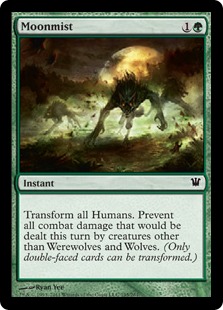
Moonmist

I guess it's best fur the final product.


This gimmicky card from Innistrad is a weird spell. Although we picture awesome board states of them swinging into our untapped Human Werewolves and flipping them at instant speed for profit, in most games, I've just seen Moonmist be a Fog. It is often an irrelevant or highly conditional spell that gets pretty awkward if your board includes nothing or a Wolf token, say. You're already imposing a playstyle on your opponent ("Gotta make sure I cast at least one spell.") Make the flip occur from good play and pressure, not a card slot.


Sideboard


Ancient Grudge (Swords and Phyrexian Metamorphs are everywhere.)

Full Moon's Rise (An excellent sideboard option against board-wiping effects and bad combats, as well as to push through tokens. It may even be good enough for a main-deck consideration.)

Phyrexian Metamorph (To copy Swords or flipped versions of your own werewolves that do not flip back. )

Gut Shot (As a possibility against the Human deck or to pick off utility/ramp creatures)

Beast Within (An amazingly flexible spell and skill-tester).


Here are some other considerations that didn't make the main or side...


Birds of Paradise (Instead of the Young Wolf as an option for ramp and as a flying chump blocker)

Slagstorm (Effectively destroys swarms of tokens and, if your flipped werewolves are big enough, they'll be able to shrug it off.)

Brimstone Volley (A powerful and game-closing removal spell.)

Naturalize (There are a lot of powerful artifacts and enchantments running around, and sometimes you need an unconditional removal spell for them.)

Corrosive Gale (When Daybreak Ranger isn't cutting it, effectively swatting away mounds of Spirits and even Birds of Paradise.)


Final Main Decklist


Creatures (25)


3 Wolfbitten Captive

3 Young Wolf

2 Scorned Villager

4 Mayor of Avabruck

4 Immerwolf

4 Daybreak Ranger

4 Huntmaster of the Fells

1 Bellowing Tanglewurm


Spells (12)

2 Galvanic Blast

3 Green Sun's Zenith

2 Arc Trail

4 Garruk Relentless

1 Devil's Play


Lands (23)

4 Copperline Gorge

4 Rootbound Crag

3 Kessig Wolf Run

8 Forest

4 Mountain

I didn't put a definitive sideboard here because that's highly specific to the metagame.

Sadly, I have neither the cards nor the resources to implement this deck, so I'm going to try and feed my friend Danny with whatever of these cards I come across so I can dominate vicariously through him. If nothing else, I hope to see a similar decklist make it in Top 8 at some SCG Open or FNM, so I'm just trying to be a shot-caller, I guess.


Thanks for reading! If you have a well-performing werewolf deck or suggestions to improve this theorized list, feel free to leave a comment. Until next time, don't forget to untap!

- Matt

Monday, February 6, 2012

Dark Ascension Prerelease

Dark Ascension Prerelease Report

First, let me apologize for the lack of pictures; the Blogger was being a pill.  

Now, Prerelease!

Saturday brought the fun and excitement of new cards and strategies to the casually competitive environment of a tournament, and I wanted in. I woke up excited and ready to play, and I drove off to my local shop, about a twenty-minute drive from my house. Although my city is rife with places to play, there are none near my home, so even a casual game requires a bit of legwork.

My gas tank beeped at me on the way, signifying a low tank. Darn, I thought, now I’ve gotta spend gas money instead of draft money…these are the things that go through my head.

When I arrived, I found the shop in an unusual state of emptiness. I checked my phone (which serves as my watch as well as a billion other functions), and I was not that early. I trotted back to the judge’s table and asked Chris, our friendly resident judge, and he explained that there were actually multiple Sealed events today, as opposed to the usual side-draft. This might explain the smaller numbers, so I held on hope that my flight would be a big group.

As noon passed, it didn’t get any warmer outside, but the atmosphere had swelled into an excited frenzy of activity within doors. Shortly after noon, the judges called for seating pairings, and we all gathered at our assigned location, eager to rip open some fresh booster packs. My event contained about 55 players, I believe, which is probably the smallest sealed event I’ve been a part of. The smallest was probably Innistrad or Scars of Mirrodin, which were about 70 a piece. The largest prerelease I’ve ever attended was either Coldsnap, Time Spiral or Lorwyn…one of those reached 600 attendees.

Although I’d perhaps played a game or two with the people around me in the past, I didn’t know any of them by name. I struck up some Magic-related conversation with my neighbors, discussing the cards I thought would be strong or weak. As we got our stack of six packs, three each of Innistrad and Dark Ascension, we tore them open and registered them. Some people looked at the new cards as they flipped through them, learning about them for the first time. I continued to chat with my neighbors, but as the judge called to see who had not finished registering, I was one of only a few who raised their hands. I was surprised, as I usually finish quickly. I made a comment to this regard, and someone down the table called out, “well, you haven’t stopped talking since you sat down!” He was right, but Magic has always been a social game for me, and it’s more about the person across from you than the forty or sixty cards you shuffle up. That being said, I’m sure my little pod could have used some peace and quiet.

The pool I opened was marginal; no Sorin or Liliana or any of that business. A nearby player had opened superbly, getting a Devil’s Play, Geist of Saint Traft and some other Limited bombs. I hoped to get that one as we each took our rubber-banded pools and passed them in a randomly assigned direction.

Needless to say, I did not get the awesome Spirit/Devil stack. Rather, I got a pile of sheer refuse. I have played in at least a dozen pre-releases and releases, and I’ve never gotten a pool this bad. I moved to a table by myself to build in privacy.


My pool.  Click for a bitter picture!

Although the picture is a bit small, I had no bombs, very few uncommon staples. My rares were a Call of the Kindred (with no tribal synergy to speak of in the pool), a Thraben Doomsayer without white support outside of two Rebukes, an Unbreathing Horde with exactly three zombies across the entire pool, an awkwardly priced Curse of Bloodletting, a Ludevic’s Test Subject, with about four other blue creatures, and my only two good rares, Stromkirk Noble and Manor Gargoyle. No mythics, no meat, and all slop.

My white was hilarious slim (three creatures) and was decidedly lacking in win conditions and Geist-Honored Monks, so I cut that first. I looked at the blue, and besides a Test Subject, Stitched Drake and a Puppeteer Spirit (Niblis of the Breath), there was nothing else, so I more reluctantly set that aside.

That left a Jund-colored pile. I looked at green and found very little endgame/win conditions so I decided to set it aside despite the presence of some conditionally good cards like Prey Upon and the new Lambholdt Elder who flips into a Curiosity-laden 4/5 Werewolf.

This left Black/Red, but my curve was very screwy and very top-heavy, so with about two minutes left to build, I scrapped the abstractly better black for the more consistent and playable green, going for a black splash for Undying Evil and for the Fires of Undeath flashback. I forewent a Victim of Night, as I thought three black sources would make it too difficult to cast it reliably, or even at all. I was still sleeving my cards as I sat down to my first round of five.

Before I go into these matches, let me give this disclaimer. Despite my best intentions of taking notes after the matches to ensure accuracy of reporting, hunger and pick-up games with friends won out, and so these matches are completely from memory. If an opponent from the prerelease reads this, please forgive any inaccuracies as they are unintentional.

Match 1 – Paul (R/G)

I sat down across from Paul, a slender, clean fellow perhaps a couple years my junior. His glasses tipped forward on the bridge of his nose as he peered down at his unsleeved stack of 40 cards. As I unfolded my borrowed World of Warcraft playmat, I glanced at the win/loss slip and gathered his name. We chit-chatted about our decks and after we wished each other luck, we both responded with the modest admission, “well, I’ll need it!”

As Game One played out, I developed my board just a little better than he did. He got flooded and I smacked him to death with some Darkthicket Wolves and a flipped Scorned Villager. Somberwald Dryad was also an allstar, and I curved well enough that she got to contribute four or six points of leafy damage.

Game Two, however, was a closer game. He started to build up land after land and was able to hold off my more anemic assault. Eventually, after he lost some life and creatures, he tapped out for a Ghoultree.

I stared at the frightening 10/10; how was I going to kill that? Before long, it was in the red zone, and I was throwing creatures under the proverbial bus to preserve my vitality, but in two unimpeded turns, he slashed away my life total in two powerful smacks.

Although I didn’t sideboard anything in after Game One, I quickly threw in a Traitorous Blood with the intention of pushing hard then, as he plays out the Ghoultree, I can snatch it for that one crucial turn and win the match.

Sadly, I never saw that or my other answer for that card (Into the Maw of Hell), and the Ghoultree made even quicker work of me. At my concession, he breathed a sigh of relief, seemingly unaware of how critical his Ghoultree was. He was a good player that, despite having a less than optimal draw first game, had the finisher that my deck so desperately needed.

0-1

Match 2 – Tony (W/B)

After a session of ruminating and super-shuffling (basically, sitting at an empty table shuffling the life out of my cards), I settled into Round 2. Across from me was Tony, a cheery-smiled, dark-haired guy. He shuffled up a black-sleeved deck, and the conversation was more succinct; we each had a match loss and another loss for either of us would surely keep us out of the prize pool.

We went to battle, and his deck, a black/white concoction of non-token zombies and spirits came back from the afterlife to fight for him. I assembled an army as well, and with a full board, we carefully calculated combat math and raced in a sense. With a final attack, he had me down to single digits. When I returned fire, he attempted to block with his Gravecrawler; I informed him that it cannot block, and he scooped. He looked through what I assumed to be his sideboard as he grumbled playfully (if that makes sense). After a moment, he went up to the judges table and returned with a checklist card. He sat down and we started Game Two.

It took about three turns and a couple spells from Tony before I realized that he was now using an unsleeved pile of cards with Mountains and Islands! He was amused (and probably encouraged) by my lack of observational skill. I tapped out for a Lambholdt Elder, and, with a Geistflame in hand to deal with the opposing Torch Fiend on my next turn, I passed.

He untapped and proceeded to enchant his Goblin Piker with a Furor of the Bitten. Argh, punished for being aggressive! Geistflame wouldn’t do it now, and he bashed for 4. I took it, hoping to draw another answer. I didn’t, and passed to flip my werewolf. On his turn, he played an Artful Dodge and a Spectral Flight, going deep. He bashed for 6 and, when my next turn revealed no answer, I scooped.

Our third game was a lucky one on my end; I curved out and bashed for lethal pretty quickly against a bunch of untapped lands, with Tony peeling mana after mana. He revealed to me that his B/W deck was actually the nuts; A Sorin, Lord of Innistrad stared back at me as he offered it to me to thumb through. And he was right, if it curved out turn four, there was about a steak’s chance in Texas that you’d lose the game.

1-1

Round 3 – Mark (W/U/R)

Before my third matchup, I looked through my pile again and decided that the green was underwhelming enough that it may be better to play the higher power cards and only two colors at the sacrifice of curve and aggression. The green was quickly outclassed, while the red and black might actually kill them. Curve and value are irrelevant if you can’t do that.

Mark, a fellow I recall playing several years ago in a Lorwyn Block Prerelease (Eventide, maybe), greeted me with a blank, focused face. Mark, a gentleman perhaps in his late thirties, wore a purple “Morningtide” shirt and a ball cap, and I can’t help but say he physically reminds me of a skinny, clean-shaven Burt Reynolds, if that helps you get an image. I almost brought this up to him, but figured it errant and inappropriate to a stranger. Mark, if you ever read this…you look like Burt Reynolds.

I shuffled up my newly-formed stack and we each went for it. I had a fairly slow start, but so did he. I got in a few points of damage, but he shrugged each time, content to take two here, and one there. My Hanweir Watchkeep threatened to get in there against his small-bodied spirits and humans, so he played Dungeon Geists to imprison it. He started to bash in, taking off three-point chunks of life a turn. He played a Silverclaw Griffin to press his advantage and passed the turn. On the backstep, I peeled a Blood Feud, surely an answer to this mess! I cast it, bidding his Griffin and Geists fight each other. The Saving Grasp in his graveyard, however, saved his Geist, allowing him to replay it and tap something else on my turn. A major misplay on my part, but with it being my only real option, I’m not sure I would have won anyway.

Game Two, he got a slow start, and so did I. I boarded in the Treason-style Traitorous Blood and boarded out the Blood Feud and hoped to get aggressive. He had enough early business to stop my Diregraf Ghoul and Stromkirk Noble nonsense, and after hitting his seventh land, he quickly tapped out for Elbrus, the Binding Blade.

Oh snap! Where was that Torch Fiend?

He threw it on some of the Townsfolk he had Gathered earlier, and each turn I threw a Geistflame or a Fires of Undeath at his tokens in desperation, preventing the blade from flipping. Finally I got a stable blocker out. But Mark was prepared; a Claustaphobia shackled him, and one of the Townsfolk got in, flipping the Blade into a massive 13/13 Demon that was about as inevitable as the next Land Before Time movie. On my turn, I failed to pull the Traitorous Blood, and I could not ironically pull the demon Into the Maw of Hell, either.

1-2

Now somewhat deflated, I hustled across the street to Dairy Queen and obtained some comfort food, as I’m pretty sure that’s all Dairy Queen serves. I enjoyed my greasy cheeseburger, chicken wrap (with dressing that I didn’t ask for) and some tasty fries. My stomach gurgled in appreciation. It was already 4:30 PM (!), and all I’d had that day was a cinnamon cookie that my wonderful wife brought me from dinner with her friend the previous night.

I came back to the shop and plopped down at an empty table, debating whether Blood Feud was worth it with so much disruption that could defuse a six-mana sorcery that required two opposing creatures to be out. Behind me, a space battle board game raged behind me. I eventually did cut the Feud in favor of Death’s Caress, a less conditional, possibly beneficial removal spell. I judge spells like Death’s Caress alongside clunky but necessary Limited removal spells like Brainspoil. I encouraged myself, realizing that even if my deck had been in its red-green incarnation, I probably wouldn’t have won against Mark either. I swallowed my pride and shuffled up as round 4 pairings scrolled on the projector.

Round 4 – Charles (B/U)

I met my first monster of the day in Charles, and by that, I mean he was chosen to play a monster in the prerelease to convert other poor saps to his undead lifestyle, err, deathstyle. He was a Zombie, but not in his person. He was an animated mustachioed fellow, happy to engage in my gratuitous small talk. We shuffled up and kept our hands, though he kept his starting seven somewhat reluctantly.

Game One began, and I got a solid, aggressive start from Diregraf Ghoul and other assorted dudes. He got a mess of Swamps, but never the second Island he needed to get into the game. The game was already over when I cut his deck.

Game Two was much more interesting. I had a fairly similar start, running out Diregraf Ghoul and getting in there. I ran out of gas fairly quickly, however, and he played down a Soul Seizer, the creature-turned-Mind Control. As I had approximately zero flyers in my deck outside of Manor Gargoyle, I knew that my flipped Tormented Pariah was going to betray me. Sure enough it did, and with no enchantment removal and the only unsavory option being to kill my own creature on an otherwise empty board on my side of the table, I scooped.

Nervous at the thought of losing a third match, I knuckled down for game three, boarding in the Traitorous Blood to seize his Soul Seizer. In retrospect, my deck wasn’t tempo/aggro enough to merit maindecking the Traitorous Blood, but I subbed it in just about every game. Regardless, I didn’t draw it the entire tournament.

For game three, I got perhaps the best draw all day, getting a Stromkirk Noble into a Torch Fiend into a Markov Patrician. It was not long before I had bashed in the zombie with his own brethren.

2-2

I was feeling much better. If I could just win the last one, I could leave 3-2 and I might just squeak in on the prizes, which extended to Top 16.

Round 5 – James (B/R)

My final opponent was James, a self-proclaimed “flamboyant” man who was probably my equivalent in years. I asked his record at the beginning of the match, and we were both 2-2. I made the asinine comment that one of us would finish the tournament positive and the other would leave negative. A sharp fellow with a strong wit, he replied, “Well, I always hope to leave positive.”

The first game was a solid one for me, getting a Diregraf Ghoul out on the draw and getting sideways with multiple guys in a hurry. We traded blows, me with my Falkenrath Torturer and he with his pair of flipped Chosen of Markovs. The board state became pretty close. Finally, the Manor Gargoyle reared its stony, pertinent head off the top of my deck. I slammed that and, despite being able to occasionally protect their summoner, his creatures came to naught and I got through with the game.

The following game brought out Stromkirk Noble and he started getting angry. I got aggressive, trading creatures; I landed the Manor Gargoyle and, though constantly fearing the Tragic Slip and getting a little greedy in one combat, he never recovered. I smashed with the Gargoyle, bringing him to two on his antique “Duelist” life counter. I showed him Geistflame with enough mana to flash it back, and he graciously resigned.

3-2

A good-spirited gent, we shook and I turned in the slip for the last round, content with a 3-2 finish. It is true I have done better, but I’ve done worse, so I was pleased. Manor Gargoyle and Geistflame were definitely the cards of the day, playing crucial defensive and offensive roles throughout the day. The sealed pool I had was pretty loose from what I can tell, but that being the case, I’m still confident I built as best as I could. I feel confident that also, if I had played the Black/Red deck the whole time, I could have won the first match (Typhoid Rats and Victim of Night tend to kill big, non-trampling dudes) and possibly the second. That kind of conjecture is fruitless though, as another matchup surely could have defeated the junk in my Rakdos trunk.

Surprising underperformers existed too. My Undying Evil, a splash in my first brew, did little for me, mostly being a reactive trick that I would rather have been something else. My Markov Patrician never gained me a drop of life, and Stromkirk Captain only saw play once; he was the main reason I could get behind B/R without splashing, as he’s a solid fighter in a format where most small fighters aren’t solid.

At the end of the day, despite my lackluster pool, I did OK. Out of 56 players at the start, I finished 19th, just outside the money. Other 3-2 records did win, but their opponents were stronger, and so they matched upwards. After the tournament, I played a couple other people with my sealed deck and did quite well, including the nice fellow who got the pool with the Geist of Saint Traft and Devil’s Play (which I eventually traded my Call of the Kindred for). Satisfied, I packed up my trusty backpack of cards, slid on my Georgetown College hoodie and headed out.


The day ended well, and I have some rising opinions about this format in comparison to other Limited Formats and Innistrad Limited. Although I think Dark Ascension added good aggro cards like Stranglethorn Geist and other undying creatures that reward you for trading in the red zone, I still think the format is fairly slow. Although I’m usually a fan of faster Limited formats, I do look forward to giving this one a try. Coming up, I’ll give some more lists of cards I dig for Timmy and Spike reasons, and I’ll tell you about my Cube.

Until next time, don’t forget to untap!

- Matt