Showing posts with label dark ascension. Show all posts

Sunday, September 9, 2012

Webber Tokens – Token Decks in a Shifting Standard Metagame


Have you ever cast Storm Herd?

Concede?  Neigh-ver!
If you ever have, either in casual or Commander, you know how awesome it feels.  Flood the board with 18, 67, or 900 1/1 Pegasus tokens!  Set yourself up for an awesome attack, an impregnable defense or a Wrath-ed blowout!  This risk, this overextension of immense swarming numbers, is part of the main drive to play a token deck.  In my opinion, token decks are their most fun when you’ve run out of table space, or you’re reduced to representing them with dice or ripped up slips of score paper.  Token decks are all about quantity over quality, and the risk of playing into blowouts like Day of Judgment, Bonfire of the Damned or Devastation Tide seem to be justified with the speed, consistency and meta-attacking power of the token archetype. 


For today’s deck, I was pondering over a recently-traded-for set of Lingering Souls in my binder.  Most people that have been keeping up with Standard over the last few months know that, earlier this year, B/W Tokens was a legitimate deck, seeing the top tables frequently and providing powerful and inevitable consistency while squashing the Delver monster with just half of this card.  Lingering Souls is still a great card, but it’s put on different hats, either as two (or four, if you can) chump blockers or evasive attackers as opposed to the efficient engine of the B/W Token machine.  Graveyard decks use it, control uses it, and most any other deck that can play both halves will sleeve it up, too.  It’s the most expensive uncommon from its set, and its flexibility and presence even in Eternal formats signifies its place among the most flexible of Standard’s sorceries. 

I considered resurrecting an aggro deck that orbited Lingering Souls, but I wanted to take it a different direction than just B/W.  I considered other token producers in Standard as well as synergetic cards and their colors.  Tokens were mostly supported by white, but black and red each provided complementary cards.  R/W Humans was a thing for a while, and combined with more token producers and buffing effects, this deck could take on a bit more of a midrange model of attack.  In an attempt to orchestrate the three-color wedge, I finally came to a first draft of this deck.

Webber Tokens

Creatures (14)

3 Champion of the Parish
2 Kruin Striker
1 Skirsdag High Priest
2 Thraben Doomsayer
2 Hellrider
2 Angel of Jubilation
2 Geist-Honored Monk

Spells (23)

4 Gather the Townsfolk
3 Krenko’s Command
3 Intangible Virtue
4 Lingering Souls
3 Oblivion Ring
2 Fervor
2 Brimstone Volley
2 Sorin, Lord of Innistrad

Lands (23)

4 Clifftop Retreat
3 Isolated Chapel
1 Dragonskull Summit
6 Plains
3 Mountain
2 Swamp
2 Evolving Wilds
1 Slayer’s Stronghold
1 Vault of the Archangel

Sideboard (15)

2 Smelt
3 Celestial Purge
3 Bonfire of the Damned
3 Safe Passage
4 Gut Shot

Deck Tech – Creatures

Champion of the Parish

I'd rather play Soul Warden, honestly.
The Champion is an unusual choice for the token deck where the tokens aren’t all Humans.  That being said, most of the creatures in this deck are Humans, one makes Humans, and a full set of Gather the Townsfolk makes him a little more interesting than, say, Doomed Traveler, the go-to one-drop for Standard white token decks.  He can quickly move out of range of burn and has a shot at surviving a Bonfire, plus I just think he’s a lot more of a threat than the Traveler, who is just a 1/1 that turns into another 1/1.  I wanted to be all in on the plan, and he really was the best one drop I could think of. 

Kruin Striker

Akoum Battlesinger, is that you?
I loved Akoum Battlesinger when he was legal.  The Striker feels very similar to her, and the added benefit of trample means that something’s going to hit.  A cast and flashbacked Souls will make this a Ball Lightning.  Like the Champion, you don’t have to work to make this guy powerful.  Just cast your spells.  A very aggressive card, this guy rarely saw play outside of the atrocity that was R/W Humans in AVR Limited, and here’s a chance for him to be a more fair and balanced contributor. 

Skirsdag High Priest

Oh, your Searing Spear doesn't exile?
The High Priest, while synergetically a Human and cheap enough to not disrupt the curve, makes combat very difficult for the opponent.  Either the opponent takes all the damage or they block and kill one of my shrimpy tokens and suffer bringing a 5/5 beater into play.  All of my token producing spells produce the two creatures the High Priest needs, so if this is out, your opponent will have to make a tough choice if he decides to block.  Not to mention, with Intangible Virtue, the High Priest can use your attacking fellows to make a dude without sacrificing combat pressure.

Thraben Doomsayer

“Citizens of Thraben!  If we continue on our path of aggression, a Day of Judgment will soon be on upon us!”
The Doomsayer is a nice catchall, providing a nice, flexible role.  Obviously a good and repeatable token producer, he also provides a Human body and, in a racing situation, he can morph your tiny squad of pingers into a mighty battalion of warriors.  More than two seemed excessive, and they seem on curve and synergetic enough to merit inclusion.

Hellrider 

“Behind an empty board swings a Hellrider for four.” – Grovthus, demon poet
The Hellrider puts teeth on your tokens.  Spending turns two and three making tokens then casting this on turn four might just kill your opponent or leave them mangled beyond repair.  It can also shred a planeswalker without using your combat damage step, which isn’t irrelevant in a deck without much burn.  This is a very intimidating weapon with a lot of tokens, and by himself, he’s outstanding too.  His $2.00 price tag belies the power of this little devil in the right deck.

Angel of Jubilation
Best art in the set.
This beautiful Angel is the flagship of the deck.  Although the mana cost can be pretty steep, she helps so much.  She pumps my squad, she is herself evasive, and she shuts down a large chunk of many opposing decks.  She can’t be Dismembered, your guys can’t be Gut Shotted, Falkenrath Aristocrat cannot protect herself, Birthing Pod becomes a four mana brick, and Mono-Green Infect just crumples.  She is at her strongest right now, as Pod and Phyrexian mana spells sit at their peak of power.  Resolving her feels awesome in this deck, and every turn she sticks around, she presses victory.

Geist-Honored Monk

Cloudgoat Monk.
At the top of the curve, the Monk provides a simple service, adding to the token field and maintaining a kickin’ bod.  Resistant to removal (as you basically just Midnight Haunting’ed if she dies,) she provides a powerful single beater for the deck or a powerful defender against massive ground pounders.  With any haste provider, she can finish the game all by her onesie.  You get a lot for what you pay. 

Spells

Token Producers and Supporters – Gather the Townsfolk, Krenko’s Command, Lingering Souls and Intangible Virtue


Each of the three producers provides the front line of this deck.  Krenko’s Commands are essentially Gathers 5-7, and Lingering Souls are just amazingly efficient, counter resistant producers.  The Virtues’ role is obvious.  Nothing you’re not expecting here, so let’s move along…

Removal Suite – Oblivion Ring and Brimstone Volley

 
A light five spells make up the entire removal of this deck.  That’s not very much, I’d only ever encounter one or two a game on average.  Frankly, though, part of removal’s job for an aggro deck is to press aggression as opposed to dealing with a threat.  That’s why Vapor Snag is so good in Delver matchups.  When I’m playing tokens, though, I bypass their removal through sheer numbers, not force.  I don’t really need to bounce or kill their team, as most of the time, I can have more than enough attackers and more than enough blockers.  Oblivion Ring is there for those gotta-answer problems, like an oppressive enchantment, planeswalker or artifact.  Most of the time the creatures won’t be the problem.   I don’t mind their creatures, as it provides a disincentive for global Wrath effects.  The ring is elegant, flexible, and on-time removal when I need it.  Brimstone Volley serves a dual purpose, either as a finisher or as an answer to a powerful creature.  Tokens tend to get themselves smitten here and there, and this simple instant can take a quarter of their life for three mana.  If the pressure is on, it can just flat finish the job.  Brimstone Volley has a good home here.

Fervor

The Rural Juror's Urban Fervor. 
This card signals I’m going elbow deep.  Truthfully, though, as with many aggressive decks, haste is always a welcome static ability.  With the sorcery nature of this deck, giving my creatures a bit of “instant” quality goes a long way.  Casting a Kruin Striker and a token producer and bashing with all of it is a huge game.  Resolving a Geist Honored Monk on an empty board hits just as hard as a Thundermaw Hellkite and is harder to completely block.  I wanted to draw it, but never more than one per game (even if it got destroyed), so I settled on two.  Having this out means your opponent is going to want to be ready for a veritable charge of hasty tokens.  With a Virtue out, combat will nearly always be in your favor.

Sorin, Lord of Innistrad

The Man in Black…and white.
The redeemed vampire provides the same support here that he did in the old B/W archetype.  I’m splashing black for a couple other cards, so he seems like a fine inclusion.  All of his abilities are relevant in this deck, adding to the token swarm, pumping all tokens forever, or selectively eliminating my opponents’ problem threats.  The menagerie of tokens I create means he’ll rarely tick down unless I tell him to, meaning his ultimate is in legitimate range.    

Mana Base

This was the hardest part of creating this deck.  Having three colors each play major roles was a challenge, so I had to make sure I provided the right balance.  White was clearly the main color, with red right behind and black in the rear.  Thus, most lands, in one way or another, produce white, many produce red and some produce black.  Hitting it all at the right point would be a challenge, too.  I only had room for two non-colored lands, and each was powerful enough to be OK.  The Stronghold could turn any freshly played token or creature into a solid attacker and blocker, and the Vault makes a deadly defense or a potent, life-swinging attack force. 

Sideboard

The sideboard was surprisingly easy to craft once I knew what I wanted to do with this deck.  Smelts are nice, cheap and narrow answers for the many artifacts that plague Standard tables.  Celestial Purge is a ruthlessly efficient choice for dealing with the R/B Zombie squad as well as tricky black planeswalkers or enchantments, like Liliana of the Dark Realms or Curse of Death’s Hold.  Bonfires belong in the board for a mirror match or some other quantity-based creature deck; the deck’s mana is tricky enough that I don’t think it’s the best thing I can do on my turn, and being three colors with fairly limited fixing makes it even harder to cast on the Miracle.  Safe Passage is a great anti-Bonfire card, and it helps make racing easier, preventing a big attack from a two-color aggro deck, and it can blank a Mono Green Infect attack that goes for the throat.  It provides a nice blowout opportunity, so I gladly support this classic inclusion.  Gut Shots make up the only sideboard playset, mainly for all the usual targets: mana dorks, Infect creatures, unflipped Delvers and Snapcaster Mages.

It took me a while to tweak this deck like I wanted it, but after settling on the spell counts, the mana base, and the sideboard, I played it this past Tuesday at Something2Do’s Standard tournament.  After I pulled out all of the token cards I had for the corresponding creature types, I was ready to roll!

Round 1 – Dalton (B/R Midrange)

Dalton and I shuffled up and had some pleasant chit-chat; he’s a fairly new player, freshly inducted earlier this year after Dark Ascension.  With a friendly handshake, we started up.

I got a fairly piddly start, having to mulligan to six and making the occasional duo of tokens.  On time, he resolved a Stuffy Doll.  Immediately I started counting creatures to see how much Blasphemous Act would cost, eyeing my life total of 15.  If he had the Act, he’d just smash me.  I dropped an Intangible Virtue for my Lingering tokens and kept my ground guys back.  I waited for the inevitable Blasphemous Act, but it never surfaced and I took game 1.  In game 2, he had land trouble and my mana base sung sweet nothings in my ear.  I curved very nicely and smashed with 8 power of Souls for three unanswered turns.

1-0

Round 2 – Josh (U/B Tezzeret Post)

Josh, an experienced and confident player, kept me guessing about his deck type.  Keeping a snap six, I was ready to go.  Game 1 involved a bit of Ichor Wellspring on his side and some tokens for me.  He eventually cast Wurmcoil Engine and, unable to find an Oblivion Ring, he killed me while sitting at a healthy 30+ life.  In game 2, I decided to really go on the offensive, getting sideways about every turn in the hopes he wouldn’t draw what he needed.  Although Ratchet Bombs and Curse of Death’s Hold dispatched my tokens, a pair of Hellriders were impossible to stop, launching us into game three.  In the final game, I boarded in all my Purges (which I hadn’t included, seeing no black or red permanents in game 1).  I played Bonfires too, thinking burn might be the only way to get him for those last few points.  With Fervor down, I was getting aggressive quickly, but he animated an Ichor Wellspring with Tezzeret’s -1 and plugged me down at 5-point intervals.  Although we were racing, I was losing.  As I landed at 5 life, I thought carefully about casting my Thraben Doomsayer, who could not only tap right away with Fervor, but was online with Fateful Hour.  He had too much on defense, so I couldn’t swing for lethal, so I just sat back.  He untapped and cast Black Sun Zenith for two, smiting my Doomsayer and each token without killing his offense.  I frowned and extended the hand.

1-1

A good match, and one I would have had a fair amount of difficulty beating.  Ratchet Bomb being recurred with Trading Post was a tough glass to chew. 

Round 3 – Greg (B/W Zombie Angels)

Greg, a focused and experienced player as well, shuffled up his stack quickly as we each hoped to avoid an X-2 finish.  He got an exceptionally aggressive start, going Gravecrawler into Diregraf Ghoul/Gravecrawler on turn 2, followed by a pair of Geralf’s Messengers.  I was floored by turn 4.  Game two brought in Bonfires and Purges.  I had a team of Townsfolk ready to block his Gravecrawler on turn 2.  Celestial Purge in my hand made me feel secure.  He had four mana and only a freshly cast Messenger out and I topdecked a Bonfire.  As I didn’t have Pillars or anything of the sort, I figured I’d cast it now with the Purge sitting in my hand.  His Messenger un-died, and he untapped, resolving and equipping a sideboarded Sword of War and Peace.  I literally could not have made a worse play if I tried.  Two turns later, I was dead from a 6/5 unblockable, untargetable monster.

1-2

That was a terrible decision on my part, and it’s proof of the danger of playing with miracles; you feel like you have to cast them on the miracle to get value, but that is not the case; in fact, it’s not the case most of the time. 

Round 4 – Dakota (Frites)

Although now out of prize contention, I still had time for one more match.  Dakota was in the same position as me; a 1-2 playing the last match for fun.  Still kicking myself for my misplay (Greg and my casual match afterward saw me beat the B/W Zombie deck time and time again), Dakota and I shuffled up for our first game.  I got a nice, aggressive start and was able to put him away no-nonsense within a few turns as he dug for an Elesh Norn.  In game two, he seemed to side in more creatures, and the plethora of mana dorks garnered inclusion of all four Gut Shots.  He had a tougher time finding what he needed, and, after I smacked away a Solemn Simulacrum, I double Gut-Shotted away his only remaining one and crashed in for the match. 

2-2

MVP:  Hellrider

This card pulled a massive amount of pressure with it.  Haste and a couple tokens mean you’re probably taking a third of their life at a whack, and they weren’t even expecting it!

Sideboard MVP: Celestial Purge

Every deck I played had black cards in it, and this card is an excellent answer to each of them.  If only I knew when to cast it…

LVP:  The Mana Base and Krenko’s Command

The mana base turned out to be my biggest opponent.  The deck was far too greedy to reliably support three colors at a moment’s notice.  I found myself using Evolving Wilds for white, my most included color, just because of its overbearing weight.  In a couple games, a binned Lingering Souls or Sorin in-hand sat idle, waiting for me to hit that black source.  Krenko’s Command was more of the same, and in nearly every match I sideboarded it out first thing; I had eleven (that’s including Souls twice) token-producing sorceries, so I just didn’t need #12-14. 

Sideboard LVP: Bonfire of the Damned

This card can buy you a brand new computer game, a fancy dinner for two plus tip or, roughly, a full tank of gas, but it can’t buy wins.  Bonfire has been the underperformer in each of my decks in which it’s played over the last little while, mainly because of its intense mana commitment and its proclivity to overextension.  Only in certain matchups does ripping a Bonfire even matter, and most of the time I’d have the game anyway.  I may have just played bad matchups for it that night, but I would remove it while a third color still remains in any capacity. 

I wasn’t too pleased with the deck’s performance, as it was weak to a lot of things, and I rarely had the sick blowout plays I was hoping for.  The grass is always greener, I guess.  Still, I don’t think this deck is DOA, I just think it’s too unfocused.  Red and White were by far the strongest colors, and I could just splash a black source or two for the Souls flashbacks (as that was by far the most awesome use for a black mana in this deck). 

I rebuilt the maindeck that night with a much narrower, Boros-colored shell.

Out:

-1 Skirsdag High Priest
-2 Sorin, Lord of Innistrad
-1 Dragonskull Summit
-1 Vault of the Archangel
-1 Swamp
-1 Plains

In:

+1 Kruin Striker
+1 Oblivion Ring
+1 Brimstone Volley
+2 Chandra the Firebrand
+1 Mountain
+1 Evolving Wilds

I like Chandra better here because she’s easier to cast, she can double up your token production, remove silly blockers, and she can ramp up a Brimstone Volley for half your opponent’s life total so you can just win out of nowhere.  More of the good stuff, less of the black.  A third Evolving Wilds is fine, as I only have the Champion to cast on turn one, so I can survey my hand and plan ahead.  In playtesting, the deck plays much more smoothly, but I’m not sure if it’s better yet.

In the end, I know the deck’s concept could be supported by Ravnica’s land fixing, but I’d be waiting for Gatecrash for two-thirds of it, and, more importantly, I’m not sure the deck (or the pilot) is that good right now.  This deck survives completely intact, minus sideboard, so that’s something.  For the rest of the format pre-rotation, though, I’ll be running a deck that will nearly completely rotate, at least functionally.  I might highlight in a couple weeks if I get a chance to play it in a tournament before rotation.

Next week, I’ll hope to provide you something special in regards to our return to Ravnica, and beyond that, it’ll be time to preview the best cards for Limited and Constructed from RTR. 

Until then, don’t forget to untap! 
                  
- Matt H

Monday, April 23, 2012

DKA/ISD/ISD Format Analysis: Two Brothers Better Left Separated


Hello everyone, and welcome back to Untap Target Player!

            This weekend marks my quarterly ritual: the prerelease.  It feels like just three months ago I was suiting up for Dark Ascension’s pre-release.  Now, it’s already time for another set, and it’s a big set รก la Rise of the Eldrazi.  Cool!  I won’t go into the cards I’m digging in Avacyn Restored yet, though there are a few, but I would like to go over the experience I’ve had with the most fiscally successful draft format in my Magic career. 
            When Innistrad alone was the draft format, I found it fresh, exciting and dynamic.  Archetypes like self-mill Skaab, G/W beatdown, and the almighty Dredge Spawning deck arose, and they gave you targets to shoot at while drafting your forty-five card pile.  It was a better sealed experience for me than, say, bomb-heavy Scars of Mirrodin, where infect coursed through my pile and took all the fun out of my and my opponents’ games.  Innistrad seemed like it offered a good set to jump into, and the mechanics integrated very well to create a unique and exciting draft environment.
            Enter Dark Ascension.  Although Dark Ascension had some neat cards, I’m just going to throw this out there; I feel like DKA/ISD/ISD is one of the more droll draft formats I’ve played since I first drafted in 2006.  I’ve drafted it dozens of times now, and each time, I feel like my decks (even the ones that win) get worse and worse. 
            Back in Innistrad days, archetypes framed the mindset you had while creating your deck.  If you wanted to go G/W beatdown, you needed some Travel Preparations, Orchard Spirits, perhaps, a Gavony Township if you were lucky (or two, as I was fortunate enough for one draft).  These were the pieces that you used to construct your strategy; then, if you missed, you’d audible to make a deck with some win conditions.  The blue mill yourself needed Armored Skaabs and Deranged Assistant and such to fire on all cylinders, and the Spawning deck needed, well, Spider Spawning.  This doesn’t mean you’re railroaded onto a path if you want to build an archetype, and rarely would you construct that perfect Werewolf deck with 2 Daybreak Rangers, 3 Brimstone Volleys, and an Instigator Gang.  What it did encourage was synergetic deckbuilding while providing you legitimate, though off-the-beaten-path alternatives when you missed a key piece.  Everyone’s played a Pitchburn Devils in a Werewolf deck, a Doomed Traveler in a non-token deck, and a Vampire Interloper in a U/B control deck.
            On the other hand, Dark Ascension, for me, muddied this synergetic water.  Formerly fun and creative decks like Dredge Spawning became nearly impossible to draft, former archetypes became much worse (G/W), and other color options formerly open were completely unplayable (W/R, G/B).  Dark Ascension, though mechanical brethren with Innistrad, offered a poor experience when clashed together, in my opinion.  Just about every draft, I’d take one of the uncommon lords first and never see a tribal buddy.  I’ve had a lot of P1P1 Drogskol Captain into P1P2 Fires of Undeath; good cards from each come around and I bridge between them until I finally pull a breakaway card (say, Niblis of the Breath or Stromkirk Captain, respectively.)  This created an unpleasant and uneasy drafting experience throughout.  This may be a format where drafting ISD first would help a lot, as Dark Ascension seems to provide supplements better than bases for decks.  I just found that in about every draft I was much more excited to crack into the ISD packs.  I even played it in a professional context, and it just always felt sloppy.
            Also, DKA, although it has a couple chase cards/bombs, is a pretty low-power set, especially for Constructed.  Of the 155 cards in the set, perhaps 20 are Constructed appropriate.  That’s a lot of fluff in the middle, and fluff that will only collect dust in your shoebox.  Getting packs of DKA as a prize are usually pretty depressing, too.  In a draft the other day at my local shop, despite winning the draft and cracking five packs and including the original draft, I still came up short on my monetary investment of $15.  That leaves a filmy taste in my mouth.
            But!  BUT!  DKA did do some things right.  It gave value to new archetypes, though they were certainly harder to hit.  W/B became legit and was consistent despite a lot of double-white and double-black costed cards.  It provided opportunities to pursue unique strategies with less fear of getting killed on turn 4 by 4 3/3 Spirit tokens.  Like its parent format of triple ISD, it allowed players flexibility and exploration of new interactions.  Finally, I believe it represents a paradigm shift in draft that I think I like.  Your deck quality matters, but consistency and tight play will afford you better results than a bunch of bombs thrown higgledy-piggledy between a stack of lands and filler.  This isn’t new – I’ve seen some decks in recent formats that had no business going 3-0 but did anyway.  Luis Scott-Vargas, of Pro-Tour and Channel Fireball fame and my favorite pro player to follow, won an M12 8-4 draft that I watched with three main-decked Brink of Disasters.  That’s quality right there.
            I did have fun playing this format, but it was still with some reservation.  Every deck I built felt bad, and many were bad.  Still, there were some decks that stuck out to me as I fiddled in this format. 

            Here’s a list of the superlatives in my drafting experience of DKA/ISD/ISD:

            Favorite Deck to Draft: Green/Blue durdle.  I’m not sure why, but there was something about the tempo of it that was just addictive.  I played it only a couple times, each with mediocre success, but I certainly had more fun playing those than anything else.  I’m a player who enjoys tempo decks, but for some reason, I really dug on this one.  As a relevant sidenote, Tracker’s Insight is pretty bad if you can’t get stuff out of your graveyard.
Deck I wanted to Draft and never did: Every time I sat down, I hoped to get the W/U Spirit engine going.  It beat me in the SCG Cincinnati Draft Open Semifinals and I knew it was solid.  This deck, despite dozens of attempts, never materialized for me.  Blue, in my opinion, got the proverbial shaft in DKA.  Sure, there were a couple good guys like Geralf’s Mindcrusher (in the right deck) and Stormbound Geist and the Geistflammable Beguiler of Wills, but in general, there wasn’t a lot of quality.  Nephalia Hellkite might be the best consistent, multi-deck card in DKA, either that or Niblis of the Breath.  Either way, I had a lot of drafts where my first-picked Drogskol Captain sat in my sideboard, and many where he was resigned there after just five picks.
            Deck Everyone Drafted and I always lost to:  I sat across from a lot of R/G Werewolf decks.  Things like Wild Hunger and Immerwolf and Young Wolf all provided great additions to this auto-archetype.  My attempts at it were pretty bad, and I got trounced by more than one.  Nut flipping a Scorned villager into a Hollowhenge Beast might arguably the best play Green’s got in the format.
            Oh no, I’m drafting THIS again?:  The most consistent and, ironically, most ignored deck in the format was B/R durdle.  I’d say I went for this deck about half the time, and rarely by choice.  The red and black that was getting passed was just so good.  I have a stack of Fires of Undeath from all of my drafts, and I’m pretty sure that was the most undervalued card in all of DKA Limited.  It was easy to pick up the stuff for it, and every time I drafted it, I did at least marginally well, and many times I’d win the draft outright.  I notice it’s easier to pick this deck up in paper drafts than in MTGO.  Not sure what that means.
            As an attempt to finish on a more positive light regarding DKA, DKAx3 was a pretty fun format while it lasted on MTGO.  It was way different than ISDx3 OR DKA/ISD/ISD.  This says a lot about the set and suggests that it’s completely separate dynamically from ISD.  I, also, was terrible at DKAx3.  Never one a single match. 
            Was it my favorite draft format?  No (it was Coldsnap, if you were curious).  Was it the worst?  No (That’d probably be ALA/ALA/CFX, for me.)  I had a lot of success in it, though, and I’ll look back on it fondly for that reason.
            As we look ahead to Avacyn Restored, which was spoiled today, I see a lot of possible interactions and wacky plays, and I look forward to another homogenous-set draft.  See you back later this week for another Meat and Potatoes, Avacyn Restored Edition!
            Until next time, don’t forget to untap!
           
PS:  Since I wrote this article on April 17th, I’ve played two more DKA/ISD/ISD drafts on MTGO to blow the last of my remaining packs and tickets. The first, where I drafted a U/W Spirit deck (finally) was hilariously underwhelming against a deck of B/R durdle.  He made quick work of me in the first round in a 1-2 match.  Second, I knuckled down into the B/R durdle deck and managed to snag a pretty consistent deck with good removal and consistency and even a Bloodline Keeper.  In the first round, I went against some failed Delver deck and easily 2-0’ed, but in the second round I played an amazingly synergetic U/W Spirit deck.  Although I was able to dispatch most of his creatures, his win condition, a Drogskol Reaver, was untouchable.  In the matches he resolved it, I had no answer for it, even a cleverly timed Traitorous Blood only delayed the inevitable.  A poor way to finish this format, but I thought it relevant to let you know.


Tuesday, March 27, 2012

Awooo!

Welcome back to Untap Target Player! I apologize for the delay; I actually wrote this article over a month ago but was having difficulty with the website and then I was out of town for a while.  Back to it!

Today, I wanted to discuss why the oh-so flavorful Werewolves of Innistrad could actually make it into a legitimate Standard deck that's got, well, teeth. Let's take a look at what can make this deck happen!

When werewolves were first previewed in Innistrad, my Timmy self got super pumped over sleeving up werewolves for Standard. Gruul was always a favorite guild of mine (it's my current "Sword" deck for Emperor); unlike Core Red aggro or B/R beats, Gruul colors have always had a certain presence, a certain power on the board that's very appealing to me. Without being blue or white, you feel in control of the board through intimidating board states. Also, haste and trample on the same card give me warm fuzzies.

So cute.

I actually think it can happen. Brian Kibler won PT Honolulu recently with an R/G deck built around ramping into the big fellows fast, and I respect that. Obviously, it was very successful. Kibs played the best deck, but I've seen plenty of different lists win on the big tables over the last few weeks. Delver, RDW, B/R Zombies, Spirits and Frites have all performed admirably.

But about tribal Werewolves? Not just the "good ones" like Huntmaster and Daybreak Ranger, but what about the other ones? Most R/G decks are Wolf Run Ramp; their goal is to get you from zero to Primeval Titan in four turns. This is fine, and again, is very effective. But here on UTP, my goal isn't just to netdeck the best list devoid of player input. There are some people that do that and you know, more power to 'em. I, however, am a brewer. I like to make terrible novel Standard decks that pull from a broader range of cards. Being a good Magic player is not about playing the best cards, but it's about taking cards and playing the best you can with them. With this philosophy, more decks are open up to try. Will they always cut to Top 8? Not always. But, when they do, you'll feel proud and reassured that your skill in play AND in building got you there. You'll never learn if you don't try; I've made a LOT of bad decks that I thought would be awesome, and more and more building and more and more play make you better, knowing which metagame interactions are likely and the best way to prepare for them.

In this instance, my friend Danny, a recent Magic convert himself, had been slinging Werewolves, and they were getting in there pretty well. While playing against him with my straightforward twist on Delver, I was constantly nervous of being bashed for lethal even from a healthy life total. Flipping was a constant concern, as my Gathered Townsfolk couldn't hold off 15-20 power of trampling werewolves. Maybe it CAN be done.

First, let's decide how this deck is going to win and how it's going to keep from losing, the two most important things to consider in competitive deck design. The win condition and prevention condition, in this case, are intimately bound; outrace your opponent. Most aggro decks have that, but this one has significantly less removal to pave the way; therefore, we must have powerful enough creatures that their claws and fangs act as removal. A card that has to chump your big dude is removal. In this case, a good offense is a good defense. Also, there is a special rule for Werewolves; any potential Werewolf candidate must be good (or at the very least relevant) on its front side to even be considered for its backside (chuckle chuckle.) So, let's take a look at cards I want to include in a Werewolf deck.

Dudes

Huntmaster of the Fells

Who knows?  The Shadow knows...

This is pretty much a no-brainer. The Huntmaster is bubbling with value; Moan of the Unhallowed is to Limited what this is to Constructed. Slows down your opponent's attacks, provides a relevant threat, flips into removal, muscle and pressure. I would play 12 if I could.

Immerwolf


Die Wulf!

Also another auto-quatro. The synergy he provides is invaluable, and the Intimidate on the side is awesome for punching in that last bit of damage against White, Zombies, Delver…

Daybreak Ranger

She's got some kinda cross-gun-bow-lista thing going there.

The flexibility of this lady is undeniable; she has a lot of power in this metagame, being able to effectively eliminate most non-Titan threats all by her lonesome. Delvers, Drogskol Captains and Spirit tokens on the front, Heros of Bladehold, Fiend Hunters, Bloodline Keepers, Phantasmal Images, and just about any token on the back. Not too shabs. She's also at a relevant spot on the curve and easy on the mana.


The Mayor is everything a Werewolf should be; synergistically relevant on both sides. If your opponent is keeping your werewolves on a leash, you can cast him as a cheap Anthem for your unflipped Humans. If your opponent lets Mayor flip (along with the rest of your Werewolves), your opponent needs an answer immediately. That buff, even with just one or two werewolves out, can push your dudes through relentlessly and provide a backup blocker on the end step. Mayor is a card I am always happy to draw.

Mayor of Avabruck

The mayor's prized hound has more in common with his master than he thinks.

This is the core of the deck's creatures. Those below are less certain, but solid inclusions nonetheless.

Wolfbitten Captive

This art looks so Ravnican to me (see artist for reason).

My feelings are fairly mixed about this fellow. If you can land him first turn, he's basically a Diregraf Ghoul if your opponent doesn't have a one-drop. Diregraf Ghoul does have the advantage of shrugging off Gut Shot, but this fellow may be one of the better drops if your field gets wiped while your opponent is on the backpedal. His ability to stand up against a Titan is not insignificant, either, and he can bash for 6 on turn three if you hit it right. He has enough potential that I believe he deserves an inclusion, although not as readily as some of the staples.

Scorned Villager

My, what generous ramp you have!
On the other hand, I am a big fan of Scorned Villager. The possibilities on Little Red Riding Hood are manifold. If you cast her Turn 2 and your opponent has no spell, you can have five mana on the back of one non-land card and three lands. That's enough to cast any spell in the deck with interest, and I think that can be very relevant off the bat or after a board sweep. The vigilance can also be relevant in explosive starts. Turn 1 Wolfbitten Captive into this on Turn 2, turn three you swing for 8 (Pump flipped Captive after swinging with the Moonscarred Werewolf). Seems fine. Leaving up Mana Leak doesn't look so good now, does it?

Young Wolf

Howl I ever use this?

The shadiest of inclusions, I was in need of another one drop to establish this as a legitimate and reliable aggro deck. That being said, though, there are two other creatures that make the Wolf even better, and his undying ability lets you swing care free, and he can also survive a board sweep. I love the idea of playing three of these on Turns 1 and 2 and then dropping the Immerwolf for mega-Wolves. One day, maybe. Relevant on offense or defense, and that's about all I'd want.

Bellowing Tanglewurm


Rumble rumble, stomp stomp, now the wurm goes chomp chomp!


Having trouble breaking through? Not anymore! Todd Anderson, a Star City Games grinder, introduced me to this card a couple months ago, and I think it's stellar. A 4/4 unblockable (against most decks) seems pretty good, and the ability to search it up provides you an easy, searchable win condition.


Spells


There aren't many, but these spells help complement the otherwise aggressive creature suite.

Garruk Relentless

Strictly eats Storm Crow.

In the words of Ace Ventura, "Like a guh-love!" I can't think of a better spell to play on turn four (or three, hehe) than this card. He paves the way for your dudes, can commit creatures to the board and, once flipped, provide synergetic black Wolves and/or the ability to fish up that Huntmaster. Also, once he's out, his abilities are abilities despite the fact they act like spells, so they don't mess with your werewolves! Holy synergy, Batman! He's much easier and more relevant than Big Garruk in this deck, too.

Green Sun's Zenith

Oh, that thing's a TREE.  Well, now I can't branch out into a funny joke.


More copies of your best creature for your particular situation! Awesome! Every creature in this deck is green (or at least half-green), so this can search for any creature in your deck. I don't think a full playset is necessary, as they do shuffle back in. I picture fetching Huntmaster the most, but the Tanglewurm and Daybreak are also good targets.

Galvanic Blast

Bonus for cheating in a Mycosynth Lattice in Standard.
It's between this and Gut Shot to me, but because I see mana being less of a problem, I imagine this will be stronger in more situations. This still kills a flipped Delver, a slightly bigger Champion of the Parish, a Mirran Crusader, a mana creature, and so on. It's strictly better than Shock, but the "better" is irrelevant. Shocks fit fine too. I wish Burst Lightning was still legal. :(

Arc Trail

Pew PYOOOO!

In most matchups, this will spread the blockers too thin for them to chump effectively and can clinch the game, too. It punishes a slow or anemic hand, and it deals with nuisance token makers, like Lingering Souls and Gather the Townsfolk.

Devil's Play

Like fire!  Hellfire!  This burning...desire...is bringing me toooooooo SIN!
A great finisher. One thing I've noticed about those decks is, if the board gets wiped or some other shenanigan, you need a way to reliable deal the last few damage after they've stabilized. This is no Banefire, but its recursion gives it some counter protection and another bit of oomph if you've got to hit them a little harder.


Close Calls

Reckless Waif


"Why not us?"
"I nunno," *nom nom nom* "fumfing abou..." *nom nom* "confiftinfee."


I love me some Waif. Landing that on Turn 1 then flipping and bashing is pretty exciting in a Limited game. However, Reckless Waif has three strikes against it. First, it's not relevant on the front. On the front, it's a Mons' Goblin Raiders, and that is not the card you want to be playing. Even on the back, a Goblin Roughrider isn't that scary, even on Turn 2. There are tons of things that answer it, and some are even for profit (Strangleroot Geist). I just picture very few board states where this would be good. Second, it's red, and therefore unsearchable with the Zenith (not like you'd want to), but it doesn't even break through with the Tanglewurm, can't block a War and Peace card, and is a ground-based and much more conditional Delver of Secrets. It was just bad news. Third, it is a completely dead draw. I do mean draw, too, because if you draw for your first turn and play it, it is unlikely your opponent doesn't have a Turn 2 play. If you're able to get in more than once, you're probably going to win anyway, and even in a normal scenario, it's still a clunky Lava Spike. I've written so much about the Waif here as a personal lesson - it was in my original concept for this deck, and I see after some consideration that it is a poor choice.

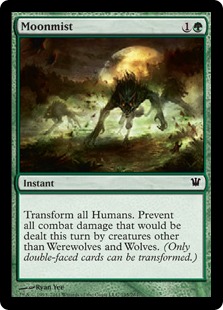
Moonmist

I guess it's best fur the final product.


This gimmicky card from Innistrad is a weird spell. Although we picture awesome board states of them swinging into our untapped Human Werewolves and flipping them at instant speed for profit, in most games, I've just seen Moonmist be a Fog. It is often an irrelevant or highly conditional spell that gets pretty awkward if your board includes nothing or a Wolf token, say. You're already imposing a playstyle on your opponent ("Gotta make sure I cast at least one spell.") Make the flip occur from good play and pressure, not a card slot.


Sideboard


Ancient Grudge (Swords and Phyrexian Metamorphs are everywhere.)

Full Moon's Rise (An excellent sideboard option against board-wiping effects and bad combats, as well as to push through tokens. It may even be good enough for a main-deck consideration.)

Phyrexian Metamorph (To copy Swords or flipped versions of your own werewolves that do not flip back. )

Gut Shot (As a possibility against the Human deck or to pick off utility/ramp creatures)

Beast Within (An amazingly flexible spell and skill-tester).


Here are some other considerations that didn't make the main or side...


Birds of Paradise (Instead of the Young Wolf as an option for ramp and as a flying chump blocker)

Slagstorm (Effectively destroys swarms of tokens and, if your flipped werewolves are big enough, they'll be able to shrug it off.)

Brimstone Volley (A powerful and game-closing removal spell.)

Naturalize (There are a lot of powerful artifacts and enchantments running around, and sometimes you need an unconditional removal spell for them.)

Corrosive Gale (When Daybreak Ranger isn't cutting it, effectively swatting away mounds of Spirits and even Birds of Paradise.)


Final Main Decklist


Creatures (25)


3 Wolfbitten Captive

3 Young Wolf

2 Scorned Villager

4 Mayor of Avabruck

4 Immerwolf

4 Daybreak Ranger

4 Huntmaster of the Fells

1 Bellowing Tanglewurm


Spells (12)

2 Galvanic Blast

3 Green Sun's Zenith

2 Arc Trail

4 Garruk Relentless

1 Devil's Play


Lands (23)

4 Copperline Gorge

4 Rootbound Crag

3 Kessig Wolf Run

8 Forest

4 Mountain

I didn't put a definitive sideboard here because that's highly specific to the metagame.

Sadly, I have neither the cards nor the resources to implement this deck, so I'm going to try and feed my friend Danny with whatever of these cards I come across so I can dominate vicariously through him. If nothing else, I hope to see a similar decklist make it in Top 8 at some SCG Open or FNM, so I'm just trying to be a shot-caller, I guess.


Thanks for reading! If you have a well-performing werewolf deck or suggestions to improve this theorized list, feel free to leave a comment. Until next time, don't forget to untap!

- Matt