Showing posts with label innistrad. Show all posts

Monday, April 23, 2012

DKA/ISD/ISD Format Analysis: Two Brothers Better Left Separated


Hello everyone, and welcome back to Untap Target Player!

            This weekend marks my quarterly ritual: the prerelease.  It feels like just three months ago I was suiting up for Dark Ascension’s pre-release.  Now, it’s already time for another set, and it’s a big set รก la Rise of the Eldrazi.  Cool!  I won’t go into the cards I’m digging in Avacyn Restored yet, though there are a few, but I would like to go over the experience I’ve had with the most fiscally successful draft format in my Magic career. 
            When Innistrad alone was the draft format, I found it fresh, exciting and dynamic.  Archetypes like self-mill Skaab, G/W beatdown, and the almighty Dredge Spawning deck arose, and they gave you targets to shoot at while drafting your forty-five card pile.  It was a better sealed experience for me than, say, bomb-heavy Scars of Mirrodin, where infect coursed through my pile and took all the fun out of my and my opponents’ games.  Innistrad seemed like it offered a good set to jump into, and the mechanics integrated very well to create a unique and exciting draft environment.
            Enter Dark Ascension.  Although Dark Ascension had some neat cards, I’m just going to throw this out there; I feel like DKA/ISD/ISD is one of the more droll draft formats I’ve played since I first drafted in 2006.  I’ve drafted it dozens of times now, and each time, I feel like my decks (even the ones that win) get worse and worse. 
            Back in Innistrad days, archetypes framed the mindset you had while creating your deck.  If you wanted to go G/W beatdown, you needed some Travel Preparations, Orchard Spirits, perhaps, a Gavony Township if you were lucky (or two, as I was fortunate enough for one draft).  These were the pieces that you used to construct your strategy; then, if you missed, you’d audible to make a deck with some win conditions.  The blue mill yourself needed Armored Skaabs and Deranged Assistant and such to fire on all cylinders, and the Spawning deck needed, well, Spider Spawning.  This doesn’t mean you’re railroaded onto a path if you want to build an archetype, and rarely would you construct that perfect Werewolf deck with 2 Daybreak Rangers, 3 Brimstone Volleys, and an Instigator Gang.  What it did encourage was synergetic deckbuilding while providing you legitimate, though off-the-beaten-path alternatives when you missed a key piece.  Everyone’s played a Pitchburn Devils in a Werewolf deck, a Doomed Traveler in a non-token deck, and a Vampire Interloper in a U/B control deck.
            On the other hand, Dark Ascension, for me, muddied this synergetic water.  Formerly fun and creative decks like Dredge Spawning became nearly impossible to draft, former archetypes became much worse (G/W), and other color options formerly open were completely unplayable (W/R, G/B).  Dark Ascension, though mechanical brethren with Innistrad, offered a poor experience when clashed together, in my opinion.  Just about every draft, I’d take one of the uncommon lords first and never see a tribal buddy.  I’ve had a lot of P1P1 Drogskol Captain into P1P2 Fires of Undeath; good cards from each come around and I bridge between them until I finally pull a breakaway card (say, Niblis of the Breath or Stromkirk Captain, respectively.)  This created an unpleasant and uneasy drafting experience throughout.  This may be a format where drafting ISD first would help a lot, as Dark Ascension seems to provide supplements better than bases for decks.  I just found that in about every draft I was much more excited to crack into the ISD packs.  I even played it in a professional context, and it just always felt sloppy.
            Also, DKA, although it has a couple chase cards/bombs, is a pretty low-power set, especially for Constructed.  Of the 155 cards in the set, perhaps 20 are Constructed appropriate.  That’s a lot of fluff in the middle, and fluff that will only collect dust in your shoebox.  Getting packs of DKA as a prize are usually pretty depressing, too.  In a draft the other day at my local shop, despite winning the draft and cracking five packs and including the original draft, I still came up short on my monetary investment of $15.  That leaves a filmy taste in my mouth.
            But!  BUT!  DKA did do some things right.  It gave value to new archetypes, though they were certainly harder to hit.  W/B became legit and was consistent despite a lot of double-white and double-black costed cards.  It provided opportunities to pursue unique strategies with less fear of getting killed on turn 4 by 4 3/3 Spirit tokens.  Like its parent format of triple ISD, it allowed players flexibility and exploration of new interactions.  Finally, I believe it represents a paradigm shift in draft that I think I like.  Your deck quality matters, but consistency and tight play will afford you better results than a bunch of bombs thrown higgledy-piggledy between a stack of lands and filler.  This isn’t new – I’ve seen some decks in recent formats that had no business going 3-0 but did anyway.  Luis Scott-Vargas, of Pro-Tour and Channel Fireball fame and my favorite pro player to follow, won an M12 8-4 draft that I watched with three main-decked Brink of Disasters.  That’s quality right there.
            I did have fun playing this format, but it was still with some reservation.  Every deck I built felt bad, and many were bad.  Still, there were some decks that stuck out to me as I fiddled in this format. 

            Here’s a list of the superlatives in my drafting experience of DKA/ISD/ISD:

            Favorite Deck to Draft: Green/Blue durdle.  I’m not sure why, but there was something about the tempo of it that was just addictive.  I played it only a couple times, each with mediocre success, but I certainly had more fun playing those than anything else.  I’m a player who enjoys tempo decks, but for some reason, I really dug on this one.  As a relevant sidenote, Tracker’s Insight is pretty bad if you can’t get stuff out of your graveyard.
Deck I wanted to Draft and never did: Every time I sat down, I hoped to get the W/U Spirit engine going.  It beat me in the SCG Cincinnati Draft Open Semifinals and I knew it was solid.  This deck, despite dozens of attempts, never materialized for me.  Blue, in my opinion, got the proverbial shaft in DKA.  Sure, there were a couple good guys like Geralf’s Mindcrusher (in the right deck) and Stormbound Geist and the Geistflammable Beguiler of Wills, but in general, there wasn’t a lot of quality.  Nephalia Hellkite might be the best consistent, multi-deck card in DKA, either that or Niblis of the Breath.  Either way, I had a lot of drafts where my first-picked Drogskol Captain sat in my sideboard, and many where he was resigned there after just five picks.
            Deck Everyone Drafted and I always lost to:  I sat across from a lot of R/G Werewolf decks.  Things like Wild Hunger and Immerwolf and Young Wolf all provided great additions to this auto-archetype.  My attempts at it were pretty bad, and I got trounced by more than one.  Nut flipping a Scorned villager into a Hollowhenge Beast might arguably the best play Green’s got in the format.
            Oh no, I’m drafting THIS again?:  The most consistent and, ironically, most ignored deck in the format was B/R durdle.  I’d say I went for this deck about half the time, and rarely by choice.  The red and black that was getting passed was just so good.  I have a stack of Fires of Undeath from all of my drafts, and I’m pretty sure that was the most undervalued card in all of DKA Limited.  It was easy to pick up the stuff for it, and every time I drafted it, I did at least marginally well, and many times I’d win the draft outright.  I notice it’s easier to pick this deck up in paper drafts than in MTGO.  Not sure what that means.
            As an attempt to finish on a more positive light regarding DKA, DKAx3 was a pretty fun format while it lasted on MTGO.  It was way different than ISDx3 OR DKA/ISD/ISD.  This says a lot about the set and suggests that it’s completely separate dynamically from ISD.  I, also, was terrible at DKAx3.  Never one a single match. 
            Was it my favorite draft format?  No (it was Coldsnap, if you were curious).  Was it the worst?  No (That’d probably be ALA/ALA/CFX, for me.)  I had a lot of success in it, though, and I’ll look back on it fondly for that reason.
            As we look ahead to Avacyn Restored, which was spoiled today, I see a lot of possible interactions and wacky plays, and I look forward to another homogenous-set draft.  See you back later this week for another Meat and Potatoes, Avacyn Restored Edition!
            Until next time, don’t forget to untap!
           
PS:  Since I wrote this article on April 17th, I’ve played two more DKA/ISD/ISD drafts on MTGO to blow the last of my remaining packs and tickets. The first, where I drafted a U/W Spirit deck (finally) was hilariously underwhelming against a deck of B/R durdle.  He made quick work of me in the first round in a 1-2 match.  Second, I knuckled down into the B/R durdle deck and managed to snag a pretty consistent deck with good removal and consistency and even a Bloodline Keeper.  In the first round, I went against some failed Delver deck and easily 2-0’ed, but in the second round I played an amazingly synergetic U/W Spirit deck.  Although I was able to dispatch most of his creatures, his win condition, a Drogskol Reaver, was untouchable.  In the matches he resolved it, I had no answer for it, even a cleverly timed Traitorous Blood only delayed the inevitable.  A poor way to finish this format, but I thought it relevant to let you know.


Tuesday, March 27, 2012

Awooo!

Welcome back to Untap Target Player! I apologize for the delay; I actually wrote this article over a month ago but was having difficulty with the website and then I was out of town for a while.  Back to it!

Today, I wanted to discuss why the oh-so flavorful Werewolves of Innistrad could actually make it into a legitimate Standard deck that's got, well, teeth. Let's take a look at what can make this deck happen!

When werewolves were first previewed in Innistrad, my Timmy self got super pumped over sleeving up werewolves for Standard. Gruul was always a favorite guild of mine (it's my current "Sword" deck for Emperor); unlike Core Red aggro or B/R beats, Gruul colors have always had a certain presence, a certain power on the board that's very appealing to me. Without being blue or white, you feel in control of the board through intimidating board states. Also, haste and trample on the same card give me warm fuzzies.

So cute.

I actually think it can happen. Brian Kibler won PT Honolulu recently with an R/G deck built around ramping into the big fellows fast, and I respect that. Obviously, it was very successful. Kibs played the best deck, but I've seen plenty of different lists win on the big tables over the last few weeks. Delver, RDW, B/R Zombies, Spirits and Frites have all performed admirably.

But about tribal Werewolves? Not just the "good ones" like Huntmaster and Daybreak Ranger, but what about the other ones? Most R/G decks are Wolf Run Ramp; their goal is to get you from zero to Primeval Titan in four turns. This is fine, and again, is very effective. But here on UTP, my goal isn't just to netdeck the best list devoid of player input. There are some people that do that and you know, more power to 'em. I, however, am a brewer. I like to make terrible novel Standard decks that pull from a broader range of cards. Being a good Magic player is not about playing the best cards, but it's about taking cards and playing the best you can with them. With this philosophy, more decks are open up to try. Will they always cut to Top 8? Not always. But, when they do, you'll feel proud and reassured that your skill in play AND in building got you there. You'll never learn if you don't try; I've made a LOT of bad decks that I thought would be awesome, and more and more building and more and more play make you better, knowing which metagame interactions are likely and the best way to prepare for them.

In this instance, my friend Danny, a recent Magic convert himself, had been slinging Werewolves, and they were getting in there pretty well. While playing against him with my straightforward twist on Delver, I was constantly nervous of being bashed for lethal even from a healthy life total. Flipping was a constant concern, as my Gathered Townsfolk couldn't hold off 15-20 power of trampling werewolves. Maybe it CAN be done.

First, let's decide how this deck is going to win and how it's going to keep from losing, the two most important things to consider in competitive deck design. The win condition and prevention condition, in this case, are intimately bound; outrace your opponent. Most aggro decks have that, but this one has significantly less removal to pave the way; therefore, we must have powerful enough creatures that their claws and fangs act as removal. A card that has to chump your big dude is removal. In this case, a good offense is a good defense. Also, there is a special rule for Werewolves; any potential Werewolf candidate must be good (or at the very least relevant) on its front side to even be considered for its backside (chuckle chuckle.) So, let's take a look at cards I want to include in a Werewolf deck.

Dudes

Huntmaster of the Fells

Who knows?  The Shadow knows...

This is pretty much a no-brainer. The Huntmaster is bubbling with value; Moan of the Unhallowed is to Limited what this is to Constructed. Slows down your opponent's attacks, provides a relevant threat, flips into removal, muscle and pressure. I would play 12 if I could.

Immerwolf


Die Wulf!

Also another auto-quatro. The synergy he provides is invaluable, and the Intimidate on the side is awesome for punching in that last bit of damage against White, Zombies, Delver…

Daybreak Ranger

She's got some kinda cross-gun-bow-lista thing going there.

The flexibility of this lady is undeniable; she has a lot of power in this metagame, being able to effectively eliminate most non-Titan threats all by her lonesome. Delvers, Drogskol Captains and Spirit tokens on the front, Heros of Bladehold, Fiend Hunters, Bloodline Keepers, Phantasmal Images, and just about any token on the back. Not too shabs. She's also at a relevant spot on the curve and easy on the mana.


The Mayor is everything a Werewolf should be; synergistically relevant on both sides. If your opponent is keeping your werewolves on a leash, you can cast him as a cheap Anthem for your unflipped Humans. If your opponent lets Mayor flip (along with the rest of your Werewolves), your opponent needs an answer immediately. That buff, even with just one or two werewolves out, can push your dudes through relentlessly and provide a backup blocker on the end step. Mayor is a card I am always happy to draw.

Mayor of Avabruck

The mayor's prized hound has more in common with his master than he thinks.

This is the core of the deck's creatures. Those below are less certain, but solid inclusions nonetheless.

Wolfbitten Captive

This art looks so Ravnican to me (see artist for reason).

My feelings are fairly mixed about this fellow. If you can land him first turn, he's basically a Diregraf Ghoul if your opponent doesn't have a one-drop. Diregraf Ghoul does have the advantage of shrugging off Gut Shot, but this fellow may be one of the better drops if your field gets wiped while your opponent is on the backpedal. His ability to stand up against a Titan is not insignificant, either, and he can bash for 6 on turn three if you hit it right. He has enough potential that I believe he deserves an inclusion, although not as readily as some of the staples.

Scorned Villager

My, what generous ramp you have!
On the other hand, I am a big fan of Scorned Villager. The possibilities on Little Red Riding Hood are manifold. If you cast her Turn 2 and your opponent has no spell, you can have five mana on the back of one non-land card and three lands. That's enough to cast any spell in the deck with interest, and I think that can be very relevant off the bat or after a board sweep. The vigilance can also be relevant in explosive starts. Turn 1 Wolfbitten Captive into this on Turn 2, turn three you swing for 8 (Pump flipped Captive after swinging with the Moonscarred Werewolf). Seems fine. Leaving up Mana Leak doesn't look so good now, does it?

Young Wolf

Howl I ever use this?

The shadiest of inclusions, I was in need of another one drop to establish this as a legitimate and reliable aggro deck. That being said, though, there are two other creatures that make the Wolf even better, and his undying ability lets you swing care free, and he can also survive a board sweep. I love the idea of playing three of these on Turns 1 and 2 and then dropping the Immerwolf for mega-Wolves. One day, maybe. Relevant on offense or defense, and that's about all I'd want.

Bellowing Tanglewurm


Rumble rumble, stomp stomp, now the wurm goes chomp chomp!


Having trouble breaking through? Not anymore! Todd Anderson, a Star City Games grinder, introduced me to this card a couple months ago, and I think it's stellar. A 4/4 unblockable (against most decks) seems pretty good, and the ability to search it up provides you an easy, searchable win condition.


Spells


There aren't many, but these spells help complement the otherwise aggressive creature suite.

Garruk Relentless

Strictly eats Storm Crow.

In the words of Ace Ventura, "Like a guh-love!" I can't think of a better spell to play on turn four (or three, hehe) than this card. He paves the way for your dudes, can commit creatures to the board and, once flipped, provide synergetic black Wolves and/or the ability to fish up that Huntmaster. Also, once he's out, his abilities are abilities despite the fact they act like spells, so they don't mess with your werewolves! Holy synergy, Batman! He's much easier and more relevant than Big Garruk in this deck, too.

Green Sun's Zenith

Oh, that thing's a TREE.  Well, now I can't branch out into a funny joke.


More copies of your best creature for your particular situation! Awesome! Every creature in this deck is green (or at least half-green), so this can search for any creature in your deck. I don't think a full playset is necessary, as they do shuffle back in. I picture fetching Huntmaster the most, but the Tanglewurm and Daybreak are also good targets.

Galvanic Blast

Bonus for cheating in a Mycosynth Lattice in Standard.
It's between this and Gut Shot to me, but because I see mana being less of a problem, I imagine this will be stronger in more situations. This still kills a flipped Delver, a slightly bigger Champion of the Parish, a Mirran Crusader, a mana creature, and so on. It's strictly better than Shock, but the "better" is irrelevant. Shocks fit fine too. I wish Burst Lightning was still legal. :(

Arc Trail

Pew PYOOOO!

In most matchups, this will spread the blockers too thin for them to chump effectively and can clinch the game, too. It punishes a slow or anemic hand, and it deals with nuisance token makers, like Lingering Souls and Gather the Townsfolk.

Devil's Play

Like fire!  Hellfire!  This burning...desire...is bringing me toooooooo SIN!
A great finisher. One thing I've noticed about those decks is, if the board gets wiped or some other shenanigan, you need a way to reliable deal the last few damage after they've stabilized. This is no Banefire, but its recursion gives it some counter protection and another bit of oomph if you've got to hit them a little harder.


Close Calls

Reckless Waif


"Why not us?"
"I nunno," *nom nom nom* "fumfing abou..." *nom nom* "confiftinfee."


I love me some Waif. Landing that on Turn 1 then flipping and bashing is pretty exciting in a Limited game. However, Reckless Waif has three strikes against it. First, it's not relevant on the front. On the front, it's a Mons' Goblin Raiders, and that is not the card you want to be playing. Even on the back, a Goblin Roughrider isn't that scary, even on Turn 2. There are tons of things that answer it, and some are even for profit (Strangleroot Geist). I just picture very few board states where this would be good. Second, it's red, and therefore unsearchable with the Zenith (not like you'd want to), but it doesn't even break through with the Tanglewurm, can't block a War and Peace card, and is a ground-based and much more conditional Delver of Secrets. It was just bad news. Third, it is a completely dead draw. I do mean draw, too, because if you draw for your first turn and play it, it is unlikely your opponent doesn't have a Turn 2 play. If you're able to get in more than once, you're probably going to win anyway, and even in a normal scenario, it's still a clunky Lava Spike. I've written so much about the Waif here as a personal lesson - it was in my original concept for this deck, and I see after some consideration that it is a poor choice.

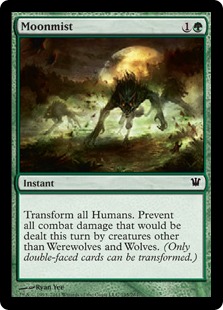
Moonmist

I guess it's best fur the final product.


This gimmicky card from Innistrad is a weird spell. Although we picture awesome board states of them swinging into our untapped Human Werewolves and flipping them at instant speed for profit, in most games, I've just seen Moonmist be a Fog. It is often an irrelevant or highly conditional spell that gets pretty awkward if your board includes nothing or a Wolf token, say. You're already imposing a playstyle on your opponent ("Gotta make sure I cast at least one spell.") Make the flip occur from good play and pressure, not a card slot.


Sideboard


Ancient Grudge (Swords and Phyrexian Metamorphs are everywhere.)

Full Moon's Rise (An excellent sideboard option against board-wiping effects and bad combats, as well as to push through tokens. It may even be good enough for a main-deck consideration.)

Phyrexian Metamorph (To copy Swords or flipped versions of your own werewolves that do not flip back. )

Gut Shot (As a possibility against the Human deck or to pick off utility/ramp creatures)

Beast Within (An amazingly flexible spell and skill-tester).


Here are some other considerations that didn't make the main or side...


Birds of Paradise (Instead of the Young Wolf as an option for ramp and as a flying chump blocker)

Slagstorm (Effectively destroys swarms of tokens and, if your flipped werewolves are big enough, they'll be able to shrug it off.)

Brimstone Volley (A powerful and game-closing removal spell.)

Naturalize (There are a lot of powerful artifacts and enchantments running around, and sometimes you need an unconditional removal spell for them.)

Corrosive Gale (When Daybreak Ranger isn't cutting it, effectively swatting away mounds of Spirits and even Birds of Paradise.)


Final Main Decklist


Creatures (25)


3 Wolfbitten Captive

3 Young Wolf

2 Scorned Villager

4 Mayor of Avabruck

4 Immerwolf

4 Daybreak Ranger

4 Huntmaster of the Fells

1 Bellowing Tanglewurm


Spells (12)

2 Galvanic Blast

3 Green Sun's Zenith

2 Arc Trail

4 Garruk Relentless

1 Devil's Play


Lands (23)

4 Copperline Gorge

4 Rootbound Crag

3 Kessig Wolf Run

8 Forest

4 Mountain

I didn't put a definitive sideboard here because that's highly specific to the metagame.

Sadly, I have neither the cards nor the resources to implement this deck, so I'm going to try and feed my friend Danny with whatever of these cards I come across so I can dominate vicariously through him. If nothing else, I hope to see a similar decklist make it in Top 8 at some SCG Open or FNM, so I'm just trying to be a shot-caller, I guess.


Thanks for reading! If you have a well-performing werewolf deck or suggestions to improve this theorized list, feel free to leave a comment. Until next time, don't forget to untap!

- Matt

Friday, January 27, 2012

Dark Ascension M&Ps

Previews weeks.  Two magical (no pun intended) words that indicate the coming of a new set, new mechanics, and new cards to play with, talk about and theorize the best and most hilarious interactions.  Since I’ve been playing, Magic has been a well-oiled machine of card creation with highly constructed and carefully planned sets.  That’s not to say that any of the fun has been taken away; instead, it means that the new sets have all the more to add to whatever metagame in which you find yourself immersed.

Dark Ascension, the 2nd set of the Innistrad Block, comes out next Friday, February 3 and already I can tell it’s a set that gives tools to casual and serious players alike for their deck building projects .  The prerelease, happening tomorrow (and at midnight for some places), is the first chance a layman like myself gets a chance to crack some packs and get my thumbs flipping through some freshly printed cards. 

I’ll have a separate article for you about my experience with the Prerelease on Saturday, but until then, let’s look at the engines of change in Innistrad Block.  The full spoiler is up, so if you’re saving yourself for Prerelease marriage, you might want to come back in a couple days.

I love ordinal lists of stuff, as does my wife, the organization queen of our home.  That being the case, I have carefully reviewed the visual spoiler and taken in as many cards as my brain will hold to memory.  Limited, as my upcoming article regarding my Cube will illustrate, is my favorite way to play Magic.  There’s a variance and excitement of the unknown that has just never gotten old.  Can you get unlucky?  Sure, but Magic is a game with an unavoidable element of luck, so it just makes it all the better.  Besides you also have a chance to get exactly what you need. 

I’m pretty greedy during preview weeks.  Part of me does want to be surprised.  But the tiny urge in my head to peek at the whole preview has become irresistible, and as soon as the full set is spoiled, I can’t help but take it all in, like eating a whole box of donuts when you just wanted to “save the other eleven for later.”

The spoiler at 12:01 AM Monday morning.
 
Within the spoiler, I wanted to single out cards I was particularly excited about.  Three lists eventually came to mind.  See, about the list thing?  The first one, the one given today, regards what I believe to be the most powerful Limited cards that you might not value as highly as you should when looking through your stack of 84 cards on Prerelease/Release day.  Sure, if you pull a Sorin, Lord of Innistrad, a Bloodline Keeper, or a Havengul Lich, they will tyrannize your deck colors.  What I’d rather talk about are those sleeper cards, the crucial spells you are likely to pull in your pool or draft and are therefore equally as likely to run into on the other side of the table.  These are the meat and potatoes of Dark Ascension, the Top 10 Innistrad Limited, well, M&Ps!

10.    Saving Grasp

This reminds me of when Westley almost falls off that cliff in The Princess Bride.  First thing that came to mind.
 
Saving Grasp, huh?  Not normally something you consider a real gamebreaker; but I think this card will be essential in control decks (fairly prevalent in the format so far).  To explain the value of this card, we’ll look at a card from a familiar Limited format.


Strictly worse.

This card does the same thing but gives you life!  Right?

Well, two major things differentiate these.  The first one, honestly, is the mana cost.  If you’re keeping three mana open, you either didn’t make a play or are hoping to get when they try to Hideous End your otherwise irrelevant creature.  It puts you a turn behind and you’re down a card, all just to save a creature from a one-sided combat or an errant kill spell.  The life gain is negligible much more often than not, too.

So why is Saving Grasp better?  I see Saving Grasp as a worse, but flashbacking Stave Off.  A flashbacking Stave Off that could do so for a white mana would be pretty awesome for sure, but I think this might be better in this format.  The ETB (enters the battlefield) potential opens up new avenues for this card to be useful in a format with a lot of ETB abilities.  Played your Fiend Hunter and then heartsick as your opponent plays a bomb?  No problem, just bounce your guy back, or better yet, let them use a spell or combat to try and kill it.  Then, replay the Fiend Hunter!  At only one mana on both sides of the spell’s coin, the efficiency and value is exceptional.  Also, it is a pretty great way to shrug off a Claustrophobia, the premier blue removal spell of Innistrad.

Morbid also makes this a choice card.  I know that I’ve played more than one Festerhide Boar and Morkrut Banshee without an active morbid trigger just because I needed more creatures to press my advantage or when I’m backpedaling, and I’m sure you have too, feeling the lost potential as you begrudgingly tap your mana to cast the overcosted vanilla creature.  Now, you can do so safely, knowing that for just one mana more, you can bounce and recast the creature when morbid would be active.  With this same logic, if your opponent offers an obviously unfavorable combat for himself, a Village Ironsmith into your Fortress Crab, say, because he intends to get a morbid trigger off his outclassed creature, you can deny him that!  Block and bounce the Crab (or other, more sensible target)!

Despite the dual mana cost, I think every blue-white sealed deck should have one.  I probably wouldn’t want two or more, but one is in there for sure.

  1. Artful Dodge
The creepiest card in the whole block.  What IS that thing?

This slick little number can be a crusher.  As opposed to other unblockable tricks of the past, the cost and repeatability of Artful Dodge will completely change the dynamic of your opponents following two turns.  It’s great for an aggressive blue/X deck (yeah, I chuckled at "aggressive," too), or even a deck that’s just got a hint of blue, perhaps a green/blue fatty deck.  The reason this is better is because of the way that it messes up combat math for an opponent who otherwise feels secure. 

Picture a board state like this: you are at 10 life, say, and your opponent is on 8.  They’re up on creatures, but they can’t really swing in there or they risk getting blown out by a Village Bell Ringer or some such.  You have a Makeshift Mauler and a flipped Howlpack of Estwald that they have to monitor.  They’re pinging you to death with Spirits, and they have plenty of Zombies to block your big guys. They just played a Ravenous Demon and flipped it.  They pass the turn, satisfied to put you under next turn.  You rip this off the top of your deck and look at a mana-dry opponent.  You’ve just won the game.

This is a great card in a race, to be sure, as your opponent will often play a blocker post combat to slow down your race.  Even if you’re just on one creature, this card can get a Kindercatch in the red zone against an army of little dudes (or big dudes), or your Murder of Crows through some flying pests, and it can be done twice.  Nightbird’s Clutches got nothin’ on dis piece! 

8. Grim Backwoods

Notice those bodies on the right tree?  Love me some Proce.

Yes, this is a rare (the only one in this list), but I think it’s subtle enough to merit inclusion. 

Altar’s Reap is a great card in this format; it activates morbid, wastes an opponent’s removal spell or profitable combat, and it has immediate value for an underwhelming creature or token. 

Grim Backwoods gives you the same advantage at a higher mana price, but it’s just as relevant late game, and it’s repeatable.  I foresee boardstates where a resolved Spider Spawning is holding them at bay, but their big Skirsdag High Cultist demon token is starting to break through.  Why not exchange those low value tokens for card advantage?  Look for your own bomb or an answer to the 5/5 flyer!  Although this is also a morbid enabler, the mana cost is prohibitive for it being a relatively powerful one.  Whose got 10 mana to pop this and cast a Morkrut Banshee?

  1. Hunger of the Howlpack
Whatchu lookin' at?

Hunger of the Howlpack is an unusual card.  It feels like Giant Growth, but I don’t think that’s how you’ll play it.  It feels like a mix between an enchantment and an instant, honestly, unlike its sorcery cousin Travel Preprations.  Although you could pull off some neat combat tricks with, like your first strike guy killing a token, then you pump one of your last-striking trading creatures for the kill, I think this will most often be played EOT after mortal combat on your opponents turn.  In this format, I think it’s definitely better on a flyer (as in most formats), but here especially, with the environment chockfull of dinky little 1/1s.  I think of it as a conditional, cheaper, instant speed Oakenform.  Relevant, but intriguing.  This combos nicely with Prey Upon (either yours or your opponents).

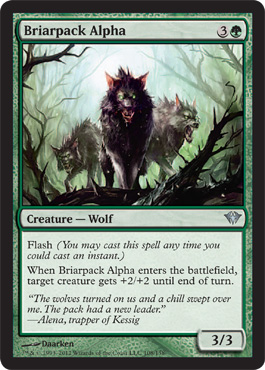
  1. Briarpack Alpha
Briarhorn is just past the tree line.

I sincerely hope that all Wizards is doing for green in Innistrad Limited helps it.  I’m tired of tapping a green-biased pile of six mana for a Kindercatch.  I want some value, pressure, tricks!

Oh, hello, Briarpack Alpha.

Perhaps its moniker is an homage; this card is a LOT like Briarhorn, one of my favorite green Limited cards.  It has a place in my Cube, and although this won’t replace it, it fills the same role.  Flashing in a 3/3 to make a better block is the prime place for it, of course, but it can also help you on the offense.  If you’re going to play a Hill Giant postcombat, why not play it mid-combat and perhaps trade it for a creature?  Good for aggressive green decks and not a bad (but unessential) splash if you’ve got some other solid green cards. 

  1. Burning Oil

He looks like a teddy bear to me.
It seems that a large amount of my cards are instants and/or combat tricks, and I promise that trend will end soon.  More than tricks, though, I like cards that make your opponent think, as it increase the likelihood they'll make a mistake.  Red/White is lacking love in this current draft environment, despite a moderate cardpool and strength of each color by itself.  One of its main problems is a plethora of mana-intensive, unfixable cards like Fiend Hunter, Crossway Vampire, Traitorous Blood, Chapel Geist and so on.  Green has ways to get mana if your other color is white, and black is more supportive and blue is more combo-friendly for red. 

This kind of spell, I feel, helps put a tempo-based Boros deck on the map.  I may be biased, as I love me some Boros.  My first competitive deck was Boros, my Standard deck before last rotation was Boros, my current competitive Modern deck is Boros…it’s just kind of how I roll.  This spell is very flexible, though, and here’s how it might look. 

In an awesome world, you might roll out a Doomed Traveler, a Bloodcrazed Neonate and a Crossway Vampire, and you’re bashing for 3 while your opponent sits on an untapped Forest and a Plains.  You get in there, and out comes the Ambush Viper to…ambush you!  That Burning Oil not only removes their pesky blocker, but it provides something else. 

With flashback, it provides the KNOWLEDGE that you can do it again.  Your opponent can’t outright block to kill your creatures.  Every creature you have gains more value in offensive or defensive combat.  They’re disinclined to attack because you can kill their thing and swing in for the win.

That being said, it is not Geistflame or Brimstone Volley, but I think it’s more useful in more red/white decks than a Rally the Peasants, which is highly conditional.  

  1. Wild Hunger
Jumanji!
This is the last combat trick, I promise.  That being said, though, nine out of ten limited games are decided in pitched battle, so I guess I shouldn’t feel so bad.

This is the card that werewolf decks need to get through.  In a world of tokens chumping your massive werewolves, trample has more value than ever.  When you get that Krallenhorde Wantons flipped, you want to kill them, not bounce off a 1/2 Spider.  Rotting Fensnake, who can easily trade up becomes bad, and you can finally kill that pesky Fortress Crab.  It’s a flashbacking Spidery Grasp on the offense!

Also, +6/+2 and trample should either kill them or smash up their creatures to the point of ruin.  Either mid or late game, this card is going to be relevant each time you cast it.  This one I can see playing multiples of, an honor not bestowed on every flashback spell in Limited. 

  1. Wakedancer
Don't go 'round tonight, 'cause it might cost your li-i-i-fe...

I’m pretty excited about this one, and it’s because my aggro roots are showing.  I love tempo swings, and I can see a lot of games this weekend going “Walking Corpse/Ashmouth Hound into your Doomed Traveler/Selfless Cathar/Avacyn’s Pilgrim,” then as they trade, you cast this guy.  It’s a Moan of the Unhallowed for one less!  This shifts the otherwise comparable effect from being good in a control deck to being ideal for an aggro deck.  Getting to MOTU for one less mana (one less back mana, at that), should prove imminently valuable for punishing a slow deck or an unkeepable hand that they optimistically kept.  It also provides that extra blocker in a sticky situation, but it’s all about pressure here.  Either the token or the human could die and you’ll still get value.  The “Human” part of it is another plus in a color with an unfortunate dearth of Humans.  There are a lot of decks that will happily find a home for this.  It’s a black Elder Cathar, a Human white staple, so that’s gotta be worth something.

  1. Dungeon Geists
"Watch out for their kiss, Harry!"
It’s a flying Fiend Hunter!  Fiend Hunter, one of the best white removal spells in Innistrad, gets some muscle and wings in a color that loves to fly.  I think Dungeon Geists is one of those cards that, like Fiend Hunter, any deck that can support it will play it, regardless of their strategy or win condition.  In most ways, I think it’s a better creature. 

Fiend Hunter doesn’t battle well; if you swing on an empty board, it’s just one point of damage and you risk a Rebuke, an Ambush Viper, a Village Bell-Ringer creating a blocker, or any other manner of problem.  On defense, a pump spell or double-flashbacked Geistflame will throw him in the bin and get their creature back with all the benefits and possibilities thereto.  Fiend Hunter is still an excellent creature.  Buuuuut….

I’m going to say that it’s better the majority of the time.  That flies in the face of a lot of commentary, I know, but here's my reasoning.  A solid evasion body that’s below cost for its colors (compare to Battleground Geist or Tower Geist) that also prevents graveyard shenanigans and affects things that help your guys (like Scourge of Geier’s Reach) seems pretty good.  Also, if something DOES happen to your Dungeon Geists mid-combat or anything, the creature is not immediately ready to go.  It’s still got to roll around to their upkeep before it’s any use.  Yes, Fiend Hunter does stop untapping or relevant activated ability creatures like Galvanic Juggernaut and Olivia Voldaren respectively, but for the non-bomb stuff, this will do the trick and provide a solid body in the meantime for any kind of blue deck.  If you are playing blue, you want this card.

  1. Tragic Slip
Really?  Would you REALLY fall into an open grave like that?  Foolish...

Oops!  I slipped and killed your biggest creature.  Clumsy me, I activated morbid and killed your utility creature for a measly black mana.  It feels like a Twinstrike, except always playable. 

This is efficiency on a stick.  Barring truly unusual circumstances, this will kill any targetable creature in the format with morbid up and the existence of this card should always pester at the back of the mind of every player who has morbid up when considering to play their bomb.  It kills ANYTHING!  Blasphemous Act is good because it can do that, but it requires that you give up board development for maximum value.  The list of otherwise difficult to answer creatures gets so much better.  Whenever you hear some troll on the Gatherer forums say “dies to removal,” THIS is the removal they mean. 

Unkicked, it can deal with most things a Geistflame can deal with, and although lacking the flashback utility of Geistflame, but it has a little more value for some creatures, like Manor Skeleton, Predator Ooze, Creepy Doll and Falkenrath Aristocrat.

The kicked version, however, kills most anything that Blasphemous Act or Into the Maw of Hell will kill, with notable exceptions, Manor Gargoyle being the first and most important that comes to mind.

This is the most powerful Common in Dark Ascension, in my opinion.  It will be everywhere, making it nearly impossible to play around if you’re facing down Swamps, and it could not be easier on the mana.  It’s also relevant every single turn of the game.  A player could play 15 creatures and 8 of these and win every single game.  Ever. 

So that’s my list.  I hope that I’m at least close to right, but we won’t know until we slap them all together on Saturday.  I hope you’re going to a Prerelease tournament near you; they’re my favorite tourneys and every match will be different. 

Two more Dark Ascension lists are yet to come, and more about my Cube and decks for all different formats. 

Until then, don’t forget to untap!

- Matt

Saturday, October 1, 2011

A Long Expected Party

Hello Untappers!  It's great to get the chance to start writing again.  I haven't had a moment to sit down and do so in a long time.  But don't worry, I plan to update more regularly.

One of the reasons I decided to post again was a small, but kind-of fun news thing...I was chosen as part of Noel DeCordova's From the Lab's "Pick a Word" contest!  In it, you chose a 3-5 letter word and built a flavor deck with that word in mind.  Each card in your deck (save basic lands) had to start with a letter from your chosen word.  I chose "BLITZ", the German word for "lightning."

Yes, sir.
You can see the rest of the contest winners here.

The world of Magic is on its back right now as Innistrad released yesterday.  The new set of vampires, werewolves and Stephanie Meyer tropes is in full swing.  It's a set that many commentators have declared as the most flavorful set in Magic, and I'm not one to disagree with them.

For me, the new rotation means two things.

First, and most unfortunately, my staple deck for Standard rotates out.  My W/R Ally deck's sun has set; the Zendikar staples served me well throughout the duration of Zendikar legality, back from the Jund and Boss Naya days of Alara/Zendikar to its twilight years swatting CawBlades away.  It was beautiful in its simplicity; the best W/R allies, some Oblivion Rings (which drifted in and out of legality in the middle), some Lightning Bolts and Burst Lightnings, and my 4 Arid Mesas.  Those lands, a staple for most "Spikes" (high-tier tournament mongers), were the crown jewel of my otherwise budget-friendly headband. 

The only reason to crack your Mesa for a Plains.  RIP 2009 - 2011.
I'm putting off de-sleeving it.  The Modern deck I want needs the Mesas, but I'll break the deck up...in a minute.

Second, the format's changed!  I love rotation as a semi-casual player - it's easier for me to manage five sets (M12, SOM block, and Innistrad) then eight (any pre-rotation format).  The card pool is smaller, the power level is (usually) lower, and it's easier to break in.  Since I posted last, I've started getting into Standard more.  That didn't kill the Timmy in me (the casual player), but I'm trying to make tighter decks that are at least marginally competitive while still pleasing the kitchen-table player in me.

I had the fortune to be able to attend the Innistrad pre-release at my local shop, Bluegrass Magic (I'm from Kentucky, if that didn't tell you.)  I've had moderate success there before (came in second in the M12 sealed release), and so I hoped for a repeat.  For those of you have never been to or played in a Sealed Format, it's a LOT of fun.  You get six booster packs, you rip 'em open, and you build your deck, which must be at least 40 cards.  Super random, and super fun!

I have never been lucky enough in all my history of pre-releases (which go back to Dissension in 2006) to pull any real "bombs," and Innistrad was no exception.  No mythic rares, and three irrelevant lands clogged up half my rares.  Bummer.  Nevertheless, in a field of 75ish players, I piloted a Blue/White Human/Spirit thingy to a 3-2 record.  Perfectly fine.

Out of all the new cards I got a chance to play with, one stood heads and shoulders above the rest.

This guy.
In a weenie deck (as mine could be called), he was pretty awesome.  Also, in fun combo-land, I played him with Stitcher's Apprentice, who makes 2/2 Homunculus tokens.  Three mana bought me a card every turn!

Underneath that creepy eye is an Azure Mage.

It was VERY encouraging, however, because many new and tournament-shy players were out to sling some cards.  I love interactive with other casual players in a tournament format, and it's not because I think they'll be softer competition.  If anything, they want to win more for the thrill than the points.  I played several of those kinds of players, and I had a great time!

As the full moon of the new Standard rises, I want to see what changes you all have made to your casual and serious decks alike.  What Standard fun are you brewing for tournaments or the casual game?  I expect to see a lot of good tribal over the next little while, so maybe that's your avenue!

Also, while we're talking about limited, I wanted to say two things.  First, I'm building a cube.

Mine doesn't have a wrap-around window or cupholders, though.
For those of you who DON'T know, a "cube" is a limited player's Victoria's Secret fantasy.  Basically, it's a box of cards that are hand-selected for use in an 8-player draft.  Pick whatever cards you like and balance them as a Magic set would be balance - make sure you have the same amount of cards and power level in every color, add gold cards, artifacts and non-basic lands, and voila!  A cube!  You don't have to keep spending money on those pesky "booster packs," and you can customize the draft however you want.  Want to build a cube of awesome high-level rares that cost too much?  Bring it on!  Want to make a tribal cube with each color supporting one or two tribes?  Sign me up!  Or, if you don't have hundreds of dollars a month for Magic, strong Modern common and uncommons?  Then you've got my cube!

My cube is 360 cards (the bare minimum for an 8 person draft), and it's well on its way to being completed.  It consists of commons and uncommons that begin in 8th Edition and have representatives from every set and block up to and including Innistrad.  If you play at Bluegrass, I'll be bringing it with me whenever I head up there.

For a limited junkie like me, it's the perfect package!

The question I want to leave you with is a fun one.  Your opponent is tapped out and confident.  You are staring at a beautiful piece of cardboard in your fist, and with it you can change the course of the game.  What is that card for you?  In other words, what single card is the most fun card to play?  Not a combo piece or anything like that, but what is your FAVORITE card to play for that giddy little moment when you start tapping your mana for it?

Mine?

I always hear a tree breaking in half when I play this.
Is it the strongest card?  No.  Is it the easiest card?  No.  Is it always relevant?  Definitely not.

Nevertheless, Overrun is arguably the most fun card in the world to play for me.  It makes me feel like roaring.  Weird, I know. 

Let me know!  Is it Storm Herd? Razia, who is a close second for me?  Obliterate? Last Word, an old college friend's fave? Or perhaps Voidslime...

Let me know in your comments.  Until next time, don't forget to untap!

- Matt