Wednesday, July 4, 2012

Top 10 M13 Cards for Limited; M13 Meat and Potatoes


Hello, Magic players!  Thanks for visiting again!  It’s time for one of my favorite times in the Magic year; Prerelease time!  I’ve been watching the previews closely in anticipation of July 7th, and now that day is nearly upon us.

I’ve always enjoyed drafting Core sets.  They’re usually a nice “back-to-basics” kind of set with the addition of some specific mechanic to mix it up; before M10 or so, most core sets were just ho-hum reprint packs, and so it was hard to have that different an experience from, say, 8th Edition to 9th Edition.  Moreover, many of the cards from middle core sets have had trouble seeing play (unless they were printed somewhere else), while the new core sets are full of playables for the four “C’s”: Casual, Cube, Commander and Constructed!

M12 was the first core set I’d drafted since Tenth Edition, and I was able to perform very well in the Sealed portion of our LGS’ Release tournament (2nd place in the final!), so I have high hopes for the 10 weeks of M13 Limited ahead. 

With all my Constructed play over the last few weeks bolstered by my negative opinion of AVR draft, I feel a little rusty tackling the spoilers with a Limited-only eye.  We’ll give it a shot though; I’m excited to step back into drafting for this set! 

Below, I’ve chosen ten cards that, within the environment of M13 Draft and Sealed, I believe to be the strongest commons and uncommons in the set.  Rares are usually more powerful and splashier, and it’s usually pretty obvious which ones are great in Limited and bad in Constructed and so forth.  I only choose commons and uncommons because, in general, this will be the vast majority of cards you will play with and against, the “meat and potatoes,” if you will.  In a draft, there are only 24 rares (a couple extra with foil rares), but you’re bound to come in contact with each common and uncommon in a given draft, and the chances are high you’ll run into them in Sealed, too.  In my opinion, there are three criteria that make a card a powerful card in Limited. 

The first criterion is an overall power level.  Efficient, flexible and/or aggressive, these cards will find their home in many decks and will affect the game in a powerful way when they’re cast.  Secondly, a card is strong in Limited if it has a presence even outside of the game.  That is, you want to play around it or remind yourself of it; you are less likely to let yourself sink to 5, say, in a format with Lava Axe.  Finally, a card is powerful if it plays well with others.  This goes along with the power level, but it is subtler.  Some cards are good in the abstract, but some, perhaps “worse” at first glance, are crucially powerful in a specific archetype or perhaps even central to it (say, Spider Spawning or Ichorclaw Myr, in recent years).

With that, let’s take at our Meat and Potatoes, M13 Edition, starting with an honorable mention that didn’t quite make the cut.

Honorable Mention

Vile Rebirth

And the piercing blue eyes of Siberian Husky.
Woah, what a neat card, and the casting cost is just right!  Sporting great flavor and mechanical design, this has potential in a variety of Limited, Constructed and Tribal formats.  In Draft, this serves a narrow, but unique purpose.  Reactively denying your opponent’s reanimation is usually fairly weak, but this is a perfectly legitimate combat trick.  I like to think of it as a Walking Corpse with flash for B.  Most of the time, this will be the case even after just a few turns.  It’s a great blocker for that huge exalted creature in a pinch, or it’s a great aggressive play after your opponent trades creatures in combat.  Its inexpensive cost also facilitates its inclusion in your spell casting schedule for any turn.  It didn’t make the Top 10 because it does require a dead creature, but its versatility once that condition is met is pretty strong.  I also love the flavor; considering the flavor text, it’s possible this was slated for Innistrad (or another set within the block) but didn’t make it into the final set.

10. Chandra’s Fury

She's Chandra-ing her lazerz!
Ok, maybe it’s a bit of a stretch, but bear with me.  This card combines the best part of two narrow cards and improves on each: Lava Axe and Scorch the Fields.

Bairn, baby, bairn!
People try to keep above five in case of Lava Axe against a lot of red Core Set draft decks.  Nothing feels worse than taking damage from creatures that you didn’t really have to and then having your opponent immediately tap down for an Axe. 

Scorch the Fields was a narrow (read: bad) card from Dark Ascension that rotted in plenty of sideboards, only seeing use against the Gather the Townfolk deck or as sideboarding against a must-answer land.  So, pretty bad.

Chandra’s Fury combines both abilities, amps up the one-sided Seismic Shudder to include anything and it’s an instant.  It can be used for either half of its effects for great effect.  Any opponent should always tarry above 4 against a red deck and think twice about playing unbuffed 1/1 tokens into 5 untapped Mountains.  It can be used to shut down an offense or even to finish off an anemic defense.  The fact that this card is common means two things: first, you will see this card, likely in multiples, and second, watch out for red decks post-board if you’re playing wee critters. 

9. Griffin Protector

Hyehhehhyehhhyehh...

Ahh, nice Griffin.  A 2/3 flyer for 3W?  Fairly average, right?  What’s that, Mr. Griffin?  You like tokens?  Good boy!

I love free pumps, and they add up quick.  If you’ve never played with Exalted or Landfall before, you will quickly find out how powerful free pumps are, especially ones you can build around!  Griffin Protector supports your token generation, and on a hard-to-block stick!  A good topdeck and a great finisher, he can hit hard, even if you just cast a creature every turn.  Bringing in a creature at instant speed (see Vile Rebirth) also acts like a little combat trick!  This common, while acceptable filler in any deck, is viciously powerful in token decks and flash creature decks.  Don’t underestimate him, or you might be Griffin food.

8. Knight of Glory/Knight of Infamy
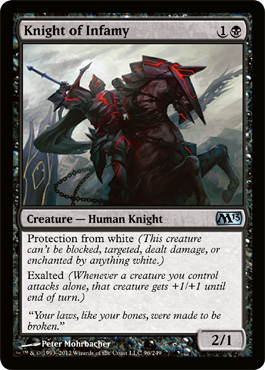
"It don't matter if you're Black or White!"
Alongside evocative art, these are great Exalted attackers.  Their protection means that, in the right deck, they will dodge removal and blockers effectively while being acceptable blockers, when needed.  They go best in concert, providing options depending on your opponent’s deck while providing either a +2/+2 bonus when either attacks alone.  Exalted decks want as many permanents with Exalted as they can get, and these are pretty good ones to grab.  They’re also good because they play very well against the mono-colored decks that might arise most (especially mono-black with all the “Swamp matters” love.)  Against mono-black, Knight of Glory is an efficient and aggressive win condition.  Time will tell the value of these.  On another note, unlike other Knight cycles in the past, they can easily be cast one after the other in the exact same deck.  This is major for Exalted’s gameplan of consistent, mounting pressure. 

7. Flames of the Firebrand

Eenie, meenie, miney, FRSHSHHHHSHH
Chandra is not a subtle woman.  Nevertheless, she hones her goggles-guided aim for this spell.  Flames of the Firebrand lumps three great cards together and gives you the option of whatever you need; Lava Spike your opponent, Arc Trail two targets, or just squash three little creatures like bugs.  The flexibility and fair cost of this spell garner something else that Red desparately needs; card advantage.  On three, you can smash a 1/1, a 2/2 and then swing with your own 1/1 and 2/2.  Now that’s comedy!  This is what red wants to be doing with their mana, and its broad appeal will make it an auto-slam for any red deck in the first few picks of a pack and provide great utility and flexibility for a Sealed Pool, even as a splash.

6. Vampire Nighthawk
I am the terror of the night!
Hey, look who’s back!  It’s Darkwing…Darkwing Duck!  Who doesn’t love this guy?  A frustratingly powerful three-drop, this fellow saw a marginal amount of medium-high level Constructed play back in Zendikar’s Standard.  In Limited, he’s a bit of a house.  Evasive lifelink is always dangerous, effectively blanking your opponent’s more meager attacks.  Lifelink is a very powerful ability, especially without any work, and the deathtouch makes him an exceptionally effective attacker and blocker; no one feels good throwing their Serra Angel under a Nighthawk.  Not much else to say except that he is a beast, his mana cost being the only prohibition from every deck that contains a Swamp.

5. Talrand’s Invocation

Fly, my pretties!
Token production can be great in Limited and Constructed.  Making two tokens is better.  Making two evasive, non-1/1 tokens is great.  Putting four evasive power on the board in blue is awesome, not to mention synergetic with myriad different strategies in the format; token, instant matters (Talrand himself, Archaeomancer, etc.)  A strong turn four attack plus these two blue blokes is just what a blue deck needs; it fits in most any deck and can count as a creature and a spell, depending on what you need more of when crafting your deck.  Think of it as a flying Moan of the Unhallowed, a great Limited card in its own right, where flight is gained in exchange for flashback.  Not too bad, and it’ll just about always be a strong play either on turn 4 or off the top to save you from an otherwise lethal combat or to land those final points of evasive damage.  Keep your eye on the skies…

4. Murder

Great Sword, Watson!
The very name echoes the simple and vicious nature of this spell.  Wizards had been beating around the bush for a long time on this one; an all-inclusive instnat kill spell in black. We’ve had Terminate, or perhaps Death’s Caress in recent history, but this one is beautiful in its three little words.  The fact that nothing except the occasional Hexproof creature will dodge this removal is very powerful; unlike Chandra’s Fury, where you could play around it to an extent, there is no way to play around Murder.  If your opponent has two Swamps and another land up, he could be tried for Murder.  The only tough part about Murder is making sure you use this precious card against the right target…

3. Primal Huntbeast

Geez, at beast he could have hunted for something more interesting.
Yes, a French Vanilla probably doesn’t belong this deep on the list, but hexproof is a very relevant ability in this game of tapping, killing, and bouncing.  Primal Huntbeast in itself is a fairly bland card, but it is strong in this format because of everything that doesn’t kill it.  In a vacuum, Primal Huntbeast dies to Wrath effects, sacrifice abilities, and just normal old combat.  However, in this format, very few non-rares can kill Primal Huntbeast outside of combat.  Pumping him up even a little bit is a secure investment, and he holds any number of enchantments and Equipments well.  He also combos sublimely with a particular one…

Suffice it to say that Hexproof has proven its usefulness in Standard, whether it’s on a white/blue legendary Spirit or a Forest-loving Treefolk.  That format has access to plenty of board wipers that can hit them; think of how much better an augmented creature your opponent can’t target is!  Miles better than previous offerings like Gladecover Scout and Sacred Wolf, this can fight well in its own right; it just helps that you can’t burn it to death.

2. Arctic Aven

Ceiling Bird is watching you die.
Let me make you a deal.  How about I give you a Turn 3 Insectile Aberration that, in exchange for two turns, can guarantee you the flip?  Oh, and I’ll throw in Lifelink?  In Limited?

Arctic Aven is one of a cycle of “multi-colored” creatures that benefit from controlling a basic land type other than the one required to cast it.  The others are very strong, too, offering trample, regeneration, haste and unblockability in their respective allied color combinations.  However Arctic Aven is wings and claws above the rest for three main reasons.

First, Arctic Aven is good even if you don’t have a Plains.  A 2/1 flyer for 2U is perfectly acceptable, albeit unexciting.  A non-Plains white source (like a Glacial Fortress) can still help you gain its ability, though.  The others are subpar filler without basic land support and, as such, rarely should be included as anything else if you don’t have the matching basic land type already in your deck.

Secondly, Arctic Aven is naturally evasive, an essential piece of a good creature.  Sure, so is Harbor Bandit (the blue/black one), but you gotta pay for his…the Aven’s got a deal with Pain Train Airlines, because he flies for free, y’all. 

Thirdly, he is the most efficient of them; a 3/2 flyer for 1WU (effectively) is way above curve and is nearing Constructed efficiency (see Talon Trooper).  Its lifelinking ability helps dampen your opponent’s attacks and its three power puts an intimidating clock on your opponent to find that answer.  Besides, this is a great addition to white/blue, a proven archetype in draft settings across history.

On a broader note, this cycle thrills me because of its natural reward for good deckbuilding and drafting.  Worldwake had a cycle like this, too (though I don’t believe nearly as good) and they were still very fun to play.  They make great inclusions in casual deck thanks to their simple, innate synergy and that little pinch of fun we get from casting an undercosted creature with an often relevant activated ability.  They will slide directly into my Cube the moment I get my hands on them, and they will reward good deck building and play throughout their entire Limited career.

1. Rancor

"I've got a bad feeling about this."
Me too, Luke.  Me too.

Reprint of the set right here.  Many have long opined that Rancor is the best enchantment ever printed, and few out there will be able to argue that once it returns to Standard.  In Constructed, this thing is an unstoppable force, turning any creature you have into a reasonable threat.  In Limited?  Well…

Rancor is a cheap, powerful and constant threat to any deck, creating unprofitable trades for your opponent, pumping your evasive creatures or protected creature (like the aforementioned Primal Huntbeast) and just about always guaranteeing you profit, all for G.  Rancor does so much work, and every single deck that can cast it can benefit from it in Limited.  It’s so powerful that several cards in this set were printed specifically with Rancor in mind, namely its single, undeniable answer: another reprint from Urza’s Block, Erase.
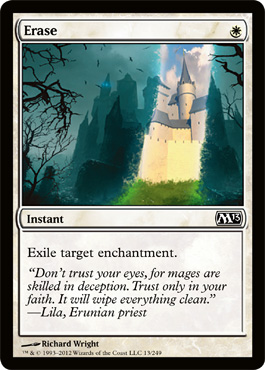
You will never be able to draw it fast enough.
With only a fizzled or Erased Rancor as possibilities, Rancor’s power and endurance will seal up a lot of Limited and Constructed matches alike.  Every green deck wants this.  Every deck wants this.  Decks that can’t cast this want to be able to cast it.  For the foreseeable future, you will be adding 2 to a creature’s power while considering combat math.  This enchantment warps this Limited format, putting value into otherwise mediocre cards (walls, for example), and removing it from others (tokens, at least on defense.)  This isn’t a bad thing; green needs some help in Limited.  Here it is, with a big trample-y bow on it!

There’s my Meat and Potatoes List, M13 edition!  I feel fairly confident about these picks and hope you find it helpful as you suit up for your Prerelease this weekend.  I will not be attending a Prerelease, as this Saturday is a milestone birthday for my father and I’d like to spend that time with him on his special day.  However, I will be participating in the fun the following weekend, looking to put this list to the test.

On a final note, I advanced my Pack to Power this weekend in a somewhat silly way.  Ben, a like-minded trader from BluegrassMagic, had a pack-to-power of his own.  He understood the trials of it and assisted me with what he could.  Here was Trade #4.

Lost:
Restoration Angel - $11.99
Plains # 232 Full Art (Zendikar) - $0.75

Gained:
*Foil* Geralf’s Messenger - $9.99
Dungeon Geists - $1.99
 FNM *Foil* Slave of Bolas – $0.99

Net Change - +$0.73

Little did I know that Restoration Angel had increased in price; Ben threw in the Slave of Bolas at the end, but if he hadn’t, I would have lost on this trade. 

I knew I wanted to trade the Foil Geralf’s Messenger flat for another Restoration Angel, which is climbing higher and higher.  Right after Trade #4, George, a frequent patron of our LGS, obliged with a straightforward trade.

Lost:
*Foil* Geralf’s Messenger - $9.99
FNM *Foil* Slave of Bolas – $0.99

Gained:
Restoration Angel - $11.99

Net Change - +$1.01

Whew!  I know that Restoration Angel is going to only go up, so having him ready to trade is a good deal.  Otherwise, trading a Zendikar Plains (effectively) for a Dungeon Geists seems like profit to me!  Can’t wait to keep working on it…

Total Pack Value - $19.44

Thanks again for reading, and feel free to leave a comment and subscribe if you like what you saw!

Until next time, don’t forget to untap!

- Matt

Saturday, June 30, 2012

Tibalt, THOU Art a Villain


"Patience perforce with wilful choler meeting
Makes my flesh tremble in their different greeting.
I will withdraw: but this intrusion shall
Now seeming sweet convert to bitter gall."

- Tybalt, Act I, Scene 5, Romeo and Juliet
 
I know, homes.  That’s how we all feel now.

In the history of planeswalkers, each has been given due attention for their game-changing ability and their iconic, mythic status.  Each and every one of the thirty planeswalkers to be released to date, with two more on the way in M13, has had a part to play.  Some have had effects in a broad sense over the entire color, like Ajani Pridemane, Jace, the Mind Sculptor, or Chandra, the Firebrand.  Some of the narrow (read: bad) ones, however, have fallen by the wayside, collecting dust as trade fodder in binders everywhere, being carelessly flipped past for the more pragmatic cards that Magic has to offer. 

With the release of Avacyn Restored, we received a burst of excitement with the release of the fiery, malicious menace Tibalt, the Fiend-Blooded. 

"Have at thee, coward!"
Tibalt is one of the most interesting planeswalkers to be released since the supertype’s advent in the Lorwyn expansion in 2007.  Tibalt has created two new landmarks for planeswalkers: he is the cheapest to cast at just two mana but, as such, is the most color intensive, requiring 100% colored mana.  No doubt about it, he is a thoroughly red planeswalker.

When he was released, there was a lot of speculation about his usefulness, terror over the power creep of planeswalkers and his admittedly aggressive cost, and hurried attempts to break him.  However, except in a somewhat obscure or obligatory (“he’s a planeswalker, he has to be good”) inclusion, he hasn’t seen a lot of love.  As is a common occurrence with over-hyped cards, Tibalt fell out of the spotlight, his price dwindling from well over $20 to barely on parity with a booster pack at about $4.  Just like a strip mall in a failing community, people abandoned it and let nature run its course.  And they left their Starbucks cups everywhere.

Skaab Ruinator, is that you?
Many deck builders far beyond my skill and experience have tried to crack the Tibalt puzzle, too, trying to find a deck that he actually helps, as opposed to promoting idealistic synergy.  I wanted to give it a shot; I wanted to create a deck in which Tibalt played an integral piece.  What persistent problems would I encounter, and what would I need to do to solve them?

I have a special interest in Tibalt outside of Magic, too, which probably drives me to make this deck happen.  Like his Shakespearean namesake, he is fiery, unpredictable and aggressive at every turn.  Tybalt, the character that is, was not a terribly deep character as Shakespeare wrote him, but rather he personified the endless, engrained struggles of the Capulets against the Montagues, stabbing Romeo’s cohorts here and sounding off on the death of Romeo’s house there.  He represented an ideal, a loyalty and a belief that, if one is a part of something or holds to a certain creed, that one in and of oneself is right across all planes of thought.  Shakespeare put a face, a heart, and a blade in the hand of a doppelganger of our own fidelity.  This stubborn but sympathetic fury is how I feel about many things in my life; one should forge one’s own path, and such a pursuit is not just a motivation but a way of travel, and I bet, if you’re reading this, you feel this way too.  In a Magic sense, as that’s what’s at hand, I feel Tybalt’s righteous, entrenched passion for brewing in general. 

Naturally, any deck with Tibalt should be very red-centric, though probably not mono-red.  Some library manipulation seems in order to mitigate the randomness of his +1 ability, and I believe that other colors are needed to further complement Tibalt’s abilities and the deck that would support him.  Similarly, we need things that don’t really care if they’re discarded and, along with that, get better depending on the other cards in the graveyard.  Also, how can we elevate Tibalt’s -4 ability into a finisher or, at best, a win condition?  His -6 ability is good in and against just about any deck, so that doesn’t take a ton of build-around brain power.  Also, who would ever let him sit there for 5 turns and not try to mess with him?

I’ve come to enjoy fair graveyard-based decks (not Dredge or Reanimator, if you’re asking.)  With a graveyard theme in mind, I gravitated towards two diametrically opposed cards that work against each other.  Although I had originally tried to super-synergize one deck, I found that, when put together, they were pretty underwhelming and fought each other at every turn.  Let’s look at the first synergy I saw.
Who knew geists could be so hot?
This is a card that Johnnies everywhere got excited about.  The possibilities are myriad in Eternal formats, but in Standard, it’s pretty much limited to flashback (except possibly Gravecrawler and Skaab Ruinator).  As much as I liked the combo potential and the possibility of achieving Magical Christmasland™ with a billion things in the graveyard and two or three Burning Vengeances out, I had to stable a prototype of this as I dry ran it.  Burning Vengeance might be the least exciting turn three play in Standard.

Instead, I decided to settle on a more interesting and powerful card that has seen a fair amount of Standard play.
"Fetch me my rapier, boy."
I have vaguely heard of Tibalt and the Pike being used in concert but I hadn’t seen a decklist (I prefer to brew independently, as previously stated.)  The deck would be chock full of cheap sorceries and instants; thus, they are easy to get into the graveyard.  The creatures to hold the Pike would need to have special qualities to make them more attractive than just a blunt instrument, but they wouldn’t need to be big, as the Pike will protect them, at least in combat.  There are tons of choices for the inexpensive creature slots, but I settled on three; Snapcaster Mage, being the most obvious, then Chandra’s Phoenix and Forge Devil.

I have to say "foh-eh-nix" aloud to spell it right.
The Phoenix seems perfect for this deck.  Tons of non-combat ways to hit a player for one, not the least of which being Tibalt’s -4 ability.  Hitting them for 3-4 with that, getting your Phoenix back and bashing with an equipped Pike seems like it’d feel pretty good. 

The Forge Devil, I believe, is an underrated card, especially in the current metagame.  There’s so much it kills, and if it kills something, it’s just straight card advantage for one life.  It kills Birds, Pilgrims, Champions of the Parish, Stromkirk Nobles, Snapcaster Mages, unflipped Delvers, and Thalia (If you know me, you know I hate Thalia).This deck doesn’t really need to go first, and a Mountain and a Forge Devil in your opening hand is a great bet against an opponent who snap-keeps on the play.  He’s a perfectly reasonable Piker, and he’s nice at getting rid of pesky tokens when trying to swing through with your Piker.  I’d like to try him, anyway.

In spell land, I liked Vapor Snag not only for its ability to help you last longer, it clears the path for your Piker and fills there hand for an extra point off Tibalt.  Also, with Reforge the Soul, permanently deal with that bounced critter!  A Reforge is almost all upside for me, filling my hand with more burn, pitching whatever instants I have in my hand and making Tibalt’s -4 ability very live.  Finally, here’s a card I’m really excited about in the deck.

Oh no, my cereal bowl!
This is a great risky-without-being-risky spell.  Run through my hand, dumping my cheap burn, then Dangerous Wager for a little more juice.  It itself is cheap and efficient, effectively being an Inspiration for 1R in this deck.  Also, I’ve discovered two notable uses of this card.  If your opponent lets through a fairly innocuous Pike hit, dump your hand!  2-4 more instants in the graveyard at instant speed!  Not as cool, no, but it does work.  Also, there are some neat stack tricks you can do.  If you cast a burn spell targeting your opponent, then, while it’s still on the stack, cast a Dangerous Wager with a Chandra’s Phoenix in hand, the Dangerous Wager will resolve and, as your burn spell resolves, you can return the Phoenix to your hand.  Value!  AND Snapcaster flashes it back easily (though you’d probably pick something else, the idea of four cards for 4 mana in red is kinda sexy.

OK, so here’s a roughly hewn list. 

Creatures (9)
4 Snapcaster Mage
3 Chandra’s Phoenix
2 Forge Devil

Spells (31)
4 Incinerate
4 Ponder
2 Thought Scour
3 Tibalt, the Fiend-Blooded
3 Runecaster’s Pike
4 Vapor Snag
3 Dangerous Wager
2 Reforge the Soul
3 Pillar of Flame
3 Bonfire of the Damned       

Lands (20)

8 Mountain
6 Island
4 Sulfur Falls
2 Desolate Lighthouse

Sideboard (15)
4 Negate
3 Dissipate
2 Geistflame
2 Desolation Tide
2 Vexing Devil
2 Slagstorm

There are some notable exclusions from this list, some of which I’ll mention here.

Delver of Secrets

Yes, he seems like he’d be good here.  The truth is, he probably is good here, but I wanted to try something different.  If I can help it, I’ll avoid putting him in this list.  He may replace Forge Devil if the metagame changes, but a 1/1 for 1 that would flip less than 50% of the time (35/60 cards will NOT flip it), I don’t consider him a good investment.  This is a fairly tailored deck, and I don’t want every U/X instant/sorcery deck to get a playset of these guys.

Other Flashback Spells

I really noodled on including more than just Geistflame, but after playing MiRUcle, which ends up playing like a draw-go most of the time, I wanted to try not running Think Twice, a card that might otherwise be good here.  Also, I’ll most likely flash it back as soon as possible, discouraging the Pike’s value. 

Counterspells

This deck wants to tap out on every turn to commit threats to the board and/or deal with their threats.  With the presence of a lot of burn and offense in this deck, I imagine main-phasing a lot of stuff, including instants.  Also, with Tibalt’s +1 ability, the counters in my hands risk getting discarded anyway.  Burn and bounce allow me to slim my hand effectively and a counterspell would just clog it up.  I do have them in the sideboard if the opponent’s decks come up with some hitherto unanswerable threat, and at that point, the deck would become much more defensive.  It’s hard for me to leave the safety net of counterspells behind, but I think it’s the right decision for this deck.

More Lands

I’m not a fan of running less than 22 lands in any Constructed deck, but I just don’t need much more than that.  My MiRUcle deck runs 22 (down from 23), and I still flood out fairly often.  Packing this deck with Pike-pumping graveyard fodder seems perfectly fine.   

Considerations


At the time that I have written the portion of the post above this point, I had not tried this deck out, but I hope to do so this evening.  I need to do a bit of trading to get the Phoenixes, Tibalt himself, and a couple Pikes.  If I can do that…

Trial #1

Last night, Tuesday the 26th, I went to Something2Do for their Tuesday night Standard.  I had to make some trades to pick up the last pieces.  Sadly, Tibalt’s were in very short supply and, in lieu of trading them, another player named Michael kindly allowed me to borrow three Tibalts for the evening.  I sleeved up and shuffled, eager to see the deck in action.

Round 1

In round 1, I sat across from John, a Magic player I’ve seen here and there for the last couple years or so.  He usually plays some sweet deck and wears a fraternity shirt, as he did last night.  We played out game one and I had difficulty sticking anything of real value.  He whittled me down to size with some Gravecrawlers for which I could not find my Pillars.  In both rounds, a Piked Phoenix threatened to steal the game, but he always had a Geth’s Verdict at the ready to drain my creature and my life total.  The first game, he got me with a Geralf’s Messenger, and the second game, he got me with Stensia Bloodhall and a Zealous Conscripts melting my 4-counter Tibalt. 

0-1

Not a great start, considering I knew I could get that matchup with a better hand.  Oh well, this is a variable card game after all.  On to round 2.

Round 2

In round 2, I was facing off against Chris, a control player playing some kind of Esper Walkers deck.  I had absolutely no chance.  In the first game, he Tamiyo-locked me and gained a bunch of life with his Pristine Talismans, killing me with Lingering Souls.  Game two was grindier, but it was never close; he had a Karn with 20 counters at one point, and he was just toying with me.  I literally ran out of win conditions and frustratingly scooped.

0-2

Round 3…maybe this deck could pull of even just one game win.  2-2 would be fine, right?  I was seriously doubting my deck construction, wondering if I had left myself too light on win conditions.  Lifegain really hurt this deck, despite the fact that it had a good amount of gas.

This round, I played against Chrissy, an opponent I had played a couple times before; I’d seen her play red-green and thought that might be what she’d have.  I felt it would be my best match-up.  Turns out that she was playing Naya Pod and this deck finally got to shine.  The deck got a solid draw, resolving and sticking a Tibalt and flooding her with direct damage.  A pair of Incinerates wrapped up game 1.  In game two, she made a stronger offense, especially with a Zealous Conscripts stealing my Piked Phoenix; the Pike still got the benefit of my instant/sorcery-filled graveyard.  She smacked me from a healthy life total down to 4.  I untapped and went into the tank for a minute.  She was at 20, and I had a Geistflame, a Pillar of Flame and a Ponder in hand, and a fully charged Tibalt out.  She was fully tapped out.  I Pillared her to 18, Pondered, drawing a Geistflame, Geistflamed her twice, popped Tibalt’s ultimate and stole her squad and hit her for exactly 16 (9 from the Piked Phoenix, 3 from her Conscripts and 4 from her Huntmaster and Wolf pal.)

1-2

Ok, so that was certainly the most fun match so far; Pod and swarm tactics seem to be very solid matchups for my deck to beat.  Although out of prize range now, I still wanted to test the deck in one more match.

Round 4

My final opponent, whose name sadly escapes me, had originally started at the high tables.  He was very nice and we enjoyed a moment of chatting; this was a nice round, as both of us were out of prize range and this was therefore just a fun round.  His deck turned out to be a clever and synergetic brew utilizing Quicksilver Amulet and mana-ramping creatures to throw huge fatties into the field.  His fatties, many of which came from the Chancellor cycle of New Phyrexia, did powerful things for him if he had them in his opener, such as the Chancellor of the Annex, which Force Spiked my first spell and Chancellor of the Tangle, which provided him an Elvish Spirit Guide on turn one.

In game one, I did fine, eliminating his mana dorks and pushing through a bit of damage.  He resolved his Quicksilver Amulet though and, with literally no way to deal with once it resolved even post-board, it quickly dominated the game.

Game two saw a much more explosive and effective start from me.  Everything worked, and I got him down to dead, keeping his board clear of mana dorks while his deck kept his board clear of lands.

Game three was a little more contested.  I had a solid lead, putting him to a precarious 7 with creatures to support lethal damage.  However, another resolved Amulet promised to complicate things.  Although I’d boarded in counter magic, I didn’t draw any until about two turns after he cast the amulet.  Then, that’s all I drew.

1-3

This deck disappointed me, but not so much so that I’m not willing to give it another go.  I learned a lot about the deck; it plays much differently than my MiRUcle deck, but that’s to be expected, and that’s part of the fun.  There can be a lot of diversity in Standard, even within the same colors.  You just have to go and find it.

When I got home, I laid the deck out (proxying the Tibalts I returned) and contemplated what needed to be done.  The deck, although different than MiRUcle at the core, was still a narrow win-condition kind of deck, and a lot of draws were fairly situational.  There were cards that stood out both for their fun and their practicality.

Of the cards that shone, Chandra’s Phoenix shined the brightest.  This card did a lot of work every time I cast it.  It came back often and was the most exciting pitch for Tibalt.  A fourth Phoenix could most certainly make this deck better in every way.  Dangerous Wager was also a star, helping give me extra juice while filling my graveyard with instants and sorceries.  Most of the time, it was a sweet topdeck with an empty hand, but there were times where my hands wouldn’t win me the game and a Dangerous Wager would exchange my hand for two random cards.  Most of the time, this was just fine.  Finally, Forge Devil turned out to be a great choice.  I always had it when I needed it and it always had targets.  Hitting a mana dork with this guy is the bee’s knees, and it was fine to pick off a token or two.  He was also a fine discard option for Tibalt’s +1 ability later in game.

There were some cards that vastly underperformed, both of which are blue cards; Vapor Snag and Thought Scour.  Vapor Snag was a bit better, but I lacked enough creatures to give it much more use beyond being a Time Walk.  It never cleared the path for an attack, which is where I think Vapor Snag is strongest, and the loss of life is a pretty small incentive.  Would I play Unsummons?  No, probably not.  Is Vapor Snag better, especially if I have to bounce my own creature and take a life loss?  Thought Scour was even worse.  Not only did I get unlucky a lot with it, it just doesn’t do anything.  I’d rather cast the instants I’m milling; a single Ponder + Thought Scour combo in round 4 was its only moment of value.  Otherwise, just give me a burn spell.

Another surprising underperformer was Bonfire of the Damned.  This $30 spell seems good in any deck that can play it, but I’m not so convinced.  It was great in MiRUcle, but suffered from the need to keep counterspell mana up.  As it is, I like it in the sideboard, but not in the main, so it’ll stay there for now.  In a deck with 20 lands, I’m just not going to get a ton of value out of it unless I’m way behind. 

Tibalt RU Pike 2.0

In its next incarnation, I added more creatures, removed some of the pointless spells and tightened up the burn package.  In dry testing, it played much better, offering more threats and forcing the opponent to play more defensively, buying me even more time for Tibalt.

-2 Thought Scour
-1 Vapor Snag
-3 Bonfire of the Damned

+3 Delver of Secrets
+1 Forge Devil
+2 Brimstone Volley

SB:
-2 Vexing Devil
-3 Dissipate
-2 Devastation Tide

+3 Bonfire of the Damned
+3 Thunderbolt
+1 Pillar of Flame

Now up to 13 creatures, Brimstone Volley seemed like a slam dunk.  It’s a Thunderous Wrath for half the cost that doubles as Incinerate in a pinch.  It may come out, but I really like it at the moment. 

Other Considerations

Stormblood Berserker

I love this guy, and he holds a Pike SO well.  There may come a point where I realize this is not a good deck for Snapcaster, in which case, 4 of these come in.  Even without bloodthirst, he is tough for your opponent to block effectively, and semi-evasion plus being powerful on his own seems like a winning combination.

Krenko’s Command

Never heard of this card?  No problem; here it is!

Ravnica fodder.
Krenko’s Command, a functional reprint of Dragon Fodder, will be equally as synergetic in this deck.  People lauded Gather the Townsfolk when it came out for its ability to be a solid turn two draw if you played Champion of the Parish or Delver of Secrets on your first turn.  I played that very deck for a while, and I wasn’t disappointed.  Almost certainly a direct replacement for Forge Devil, these will slide in as soon as possible.

Temporal Mastery

A card, probably a singleton, that can just about give me extreme value every time.  Even if I mill it, it’s Piker fodder, and in uber-mana situations, Snap it back!

Phyrexian Metamorph (sideboard)

I borrowed some for a tournament one day for my MiRUcle sideboard and I was not disappointed.  They are just financially unviable for me, considering they rotate out in three months.

Invisible Stalker

A great Piker, he’s just unimpressive by himself, which merits his absence.  After you resolve one, though, he’d be perfectly fine to throw away, and he’d go nicely with Stormblood Berserker.  His inclusion would almost certainly directly replace Vapor Snags.

Arc Trail

I have considered Arc Trail instead of Geistflame in the sideboard as it kills a large number of creatures while still pinging the opponent to recover lost Phoenixes. 

…I miss Searing Blaze.

If you can’t tell, this deck is drifting much more red than it is blue.  I like the few options that being blue brings to this deck, namely Ponder, Snapcaster and the newly inducted (and equally busted) Delver of Secrets.  What this means is that, with some tweaking, the shell of the deck could be color shifted to fit new metagames as well as to try different playstyles.  I’d toyed with a R/G Pike, or even R/W Pike using Timely Reinforcements and Fiend Hunters to keep the board clear for a Pikebearer. 

Time will tell if the newest iteration of this Tibalt Pike can get there.  I’ll most likely be trying it again this weekend, hoping to tweak it into a more consistent and formidable deck.  Despite the inherent weaknesses of this deck, it’s a blast to play.  It blends the fun of burn to the controlled chaos of a reckless red draw engine. 

No movement on the Pack to Power lately.  I haven’t time to just sit down and trade when I’ve played.  It’ll take a while to get going, I’m sure…Hopefully I'll be able to push it forward today.

Thanks again for reading!  Until next time, don’t forget to untap!

- Matt

Saturday, June 23, 2012

Pack to Power Day One – A Million Hours Remain


OK, folks, I’m gonna try it.

In this off-timed post, I wanted to delve into a fun Magic challenge.  Not a playing challenge, a deck challenge, or a building challenge, but a very human challenge. 

Every hobby, sport or vocation has an impressive goal.  Track athletes want to run a mile in under four minutes, a salesperson wants to meet a certain commission quota, and a competitive eater wants to jam fifty hot dogs down his throat without spewing acid and nitrates all over the place (well, that’d be my goal.)

Magic has these goals too, and they are just as diverse as the millions of players who play the game.  Some are simple, looking to complete that perfect deck or to X-0 a tournament.  This goal, however, is a little different; it requires patience, charisma, study and dedication.

The goal, and the process to get to it, is called “Pack to Power.” I heard about this “feat” a few months ago and, after reading Jon Medina’s primer about it, I decided to jump in.  This challenge is very simple at its core.  Get one, and only one, pack from the newest set and, using only those cards and the direct products of subsequent trades, trade for profit little by little until you have enough trade value to get one piece of Power 9, the fabled Vintage-restricted cards of yore, which, if you wanted to know, includes each of the five Moxen, Timetwister, Time Walk, Ancestral Recall, and the legendary Black Lotus.

Cost: 71 tanks of gasoline, 1,090 Chik-Fil-A sandwiches, or roughly two-thirds of your left kidney

To complete this goal in as honest and satisfyingly a way as possible, here are four guidelines to which I will hold myself as I maneuver through this process.  For brevity’s sake, I shall henceforth refer to all of the cards that came from the original AVR pack and their traded products as “the Pack.”

The four guidelines are:

  1. No adding to the Pack.  I won’t use other cards I have and either trade with myself or simply add to the Pack.  The cards that end up in there are solely original pack cards and trades made ONLY with those cards and their products. This also limits my trades to table stakes; no cash trades; no cash for their cards or their cash for my cards.
  2. No trading with a store or non-personal entity.  Most of the time I wouldn’t want to do this anyway, as they’re trading for profit, too, leaving me on the inevitably short end of the bargain. 
  3. No gifts.  Although this one is less strict, I will always trade them something in exchange for the cards of my traders.  The fairness of any trade is in the eyes of the trading partner, but they will always walk away with at least one card.
  4. Finally and most importantly, the nature of the Pack and any subsequent trades will be briefly explained to a potential trader.  Trading for profit during each transaction is the modus operandi of the Pack, and I want the trader to know that.  I don’t want to con a new player out of their powerful Constructed cards for my dubious offering unless they are already comfortable with the trade.  People play Magic for different reasons, and a card that I don’t find valuable may be very valuable for them and vice-versa.  In fact, this truth is paramount to the success of any trading challenge.  The point is that I’m not trying to claw my way to the top here; the real challenge of this endeavor is that everyone walks away pleased when they’ve traded with me.  There is no doubt that this challenge depends on the kindness of strangers and friends alike, and keeping this attitude will keep everyone happy.

Also, a bit of an addendum; although the challenge is called “Pack to Power,” I would find very little use for an actual piece of Power 9 (save the immense cash value, of course).  So, instead, I’ll be aiming to complete a comparable goal instead; I want a playset of each of the ten Ravnica Block Shocklands.  As they average about $20 a piece, a playset of each would run between $800-$900 total, roughly equivalent to most Power 9 cards.  There are three reasons I’m aiming in this direction instead. 

First, the cards will be somewhat easier to find and be more spread out; I can trade a bit of the binder for a Shockland here and there and slowly inch towards my goal while still using the Shocklands’ liquidity for other trades if needed, say, two Sacred Foundries for one Hallowed Fountain. 

Second, finding a piece of Power 9 is very hard, especially in my usual playgroups.  Most people don’t have a single piece of paper that’s worth more than my rent, so I feel this goal is more realistic while maintaining comparable parity with the normal “Pack to Power” goal. 

Finally, I’ve always wanted all of the Shocklands.  Ravnica was my first set, so I would love to own a piece of my Magic roots.  I never play Legacy, let alone Vintage, so a piece of Power is just dollar signs and bragging rights to me; Modern, on the other hand, encompasses nearly my entire play history, and these lands are the premium lands for that Format.  Even if they are reprinted in Return to Ravnica, their value will not descend much, shrinking to maybe $10-$15 per land, and to have a playset of all of the staple lands for any Modern deck I decide to build will be much more valuable to me.  I’m in no hurry, either.

I’m excited to do this for the same reason I like any restrictive challenge; I have what I have, and I have to work with it no matter how rough it is.  In a way, Pack to Power is like the Limited of trading.  “Constructed” trading lets you bring your massive, accrued card value to bear.  Like Limited, I have only the cards set before me and, with superior strategy, planning, and a healthy dose of luck, I might just pull off the win.

With that, let’s get started by looking at the singular pack with which I’ll start my journey.  My plan is, for each post, to post trades and monetary values of trades (in each direction), following Jon Medina’s example.  All prices used are from StarCityGames.com; this isn’t because I feel their prices are always accurate when considering demand, the real buying market, and their end-user business model, but they are widely and comfortably used by many Magic players and stores as a benchmark. 

On Tuesday night, I went to go play my MiRUcle deck at Something2Do in a possibly final blaze of glory, as I feared that the DCI BanHammer™ would kill crucial cards in my deck come their quarterly banning announcement this week.

After putting up an unremarkable 2-2 finish, I got a pack of Avacyn Restored, following Jon Medina’s example of getting the final set in a block (he used “Rise of the Eldrazi.”)  With my binder on top of their glass case open and ready to induct my recruits into my inaugural P2P class, I hand-selected a pack from the Avacyn Restored box and cracked, hoping it had even the smallest hint of value.  Without looking, I slid each card into my binder, only catching a glimpse of a black foil in the back of the pack. 

Here is what I ended up with.

Bright glare from overhead light is bright.
Gryff Vanguard
Dangerous Wager
Havengul Skaab
Abundant Growth
Driver of the Dead
Galvanic Alchemist
Timberland Guide
Farbog Explorer
Nightshade Peddler
Blood Artist
Gang of Devils
Commander’s Authority
Restoration Angel
[White Human Token]
Swamp # 236
*Foil* Corpse Traders

Wow, not bad!  This could have been a lot worse; I wasn’t going to buy another pack if it went bad, so this one had to be good.  I breathed a sigh of relief as I reviewed the picks.  Now, as Pack to Power is primarily a financially based challenge, let’s look at these cards in the way I’ll be seeing them for the foreseeable future.

Gryff Vanguard - $0.15
Dangerous Wager - $0.25
Havengul Skaab – $0.15
Abundant Growth - $0.25
Driver of the Dead - $0.15
Galvanic Alchemist - $0.15
Timberland Guide - $0.15
Farbog Explorer - $0.15
Nightshade Peddler - $0.15
Blood Artist - $0.50
Gang of Devils – $0.25
Commander’s Authority - $0.25
Restoration Angel - $9.99 (yup)
[White Human Token] - $0.15
Swamp # 236 - $0.25
*Foil* Corpse Traders - $0.49

Initial Pack Value - $13.43

These prices can be slightly misleading; bulk commons are not greater than one-half the cost of uncommons most of the time, BUT such trades do give me excellent value, if they’re feasible.  Converting two crappy commons into an uncommon is technically worse by these measurements, but uncommons are often in high demand and in general trade better than bulk commons.  I was lucky to pull several cards that should pull their weight; Restoration Angel, obviously, but Blood Artist, Abundant Growth and the Foil Corpse Traders should each trade very well, even for a step up (common to uncommon, uncommon to rare, etc.)  Even the “slag,” the land and the token, should be easy to trade off for a pinch of value.  In the end, that’s what the game plan is from start to finish.

I didn’t make any trades on Tuesday, as I got the pack right before I left.  However, Wednesday night I did get an opportunity to go play and trade at Bluegrass Magic; they host a casual Standard tournament there every Wednesday, where I slung MiRUcle to efficient results.  It ended up 2-1 on the night and I got a Game Day Strangleroot Geist.  Not bad for free.  More importantly though, I broke the seal on my Pack to Power trading, which I’ll highlight here!

A Magic pal of mine, Max, was there last night, and many thanks go to him for helping me get my Pack to Power off the ground; he was my partner for each of these trading sessions; I just broke them up because we broke off and then reconvened for trades after each Standard round.  He was in need of new cards and was looking to craft an EDH deck, I was happy to oblige.

The maiden trade of the Pack was definitely, but not overwhelmingly, in my favor.  I knew that the land and token were going to be something, and now I feel confident about this trade as a start.

Lost:
Swamp # 236 - $0.25
[White Human Token] - $0.15
Commander’s Authority - $0.15

Gained:
Moss Diamond (6th Edition) - $0.49
Plains # 232 Full-Art (Zendikar) - $0.75
Undertaker (Time Spiral Timeshifted) - $0.25

Net Change - +$0.94

OK, so no HUGE leap, but what I did pick up was solid, simple starters.  Moss Diamond, originally a card I wasn’t very excited about, seems to have a fairly limited application; Green EDH.  Also, I was bummed that it’s a white-bordered card (a lot of people don’t care for them, but I don’t mind: I play 4 9th Edition Mana Leaks in MiRUcle.)  After some consideration, though, I realized this is actually great budget ramp in a color and format where ramp is already encouraged.  The full-art Zendikar Plains is also in high demand, and it should trade up without a doubt.  Undertaker is a little looser, but I thought someone could find a use for it, so I felt fine making a flat trade here (if you consider the Swamp and the Undertaker a 1-for-1 trade).  Not a huge gain in value, but this is a great start; at least I didn’t lose value.

After another match of Standard passed, we came back together for more trading.

I offered him my Abundant Growth, a good common, and Driver of the Dead, a build-around common, each perhaps a cut above the average rabble of black-symbol cards.  A fairly straight trade, I ended up with a bulk-ish rare.

Lost:
Driver of the Dead - $0.15
Abundant Growth - $0.25

Gained:
Mindshrieker - $0.99

Net Change - +$0.59

Upgrading two good (but not great) commons for a low-ball rare seemed fine to me.  Worse comes to worse, I could use the Mindshrieker in my Geist of Saint Traft EDH deck.  I don’t have a problem with taking cards out of the Pack for deck use, so long as I proxy them in the binder and am willing to trade them at a moment’s notice. 

Finally, in consideration of his B/G sack EDH deck with Savra, Queen of the Golgari at the helm, we made a final Pack trade.

Lost:
Blood Artist - $0.49
Dangerous Wager - $0.25

Gained:
Earthquake (Commander) - $0.49
Phyrexian Crusader - $1.49

Net Change - +$1.24

Admittedly a generous trade on Max’s part, my offerings were still two solid cards from the new set; Blood Artist, a nice uncommon that’s seeing a lot of speculative play (see my previous article), was something I really had to get value out of.  Dangerous Wager has seen some plays in flashback/Runechanter’s Pike lists, and I actually think it’s a pretty acceptable Divination for a red deck.  Still, two rares for a common and an uncommon is generous, and I appreciate Max’s help in getting me some value.

Earthquake has been reprinted to death, but, that doesn’t mean it is without value.  Someone will always have a use for a random Earthquake.  Several years ago, in fact, I traded an Ink-Eyes 1-for-1 for an Earthquake, which even at the time was a very sour trade.  It has EDH, other multiplayer, and casual applications as well as a possible home in Cubes. 

Phyrexian Crusader, although worth significantly less than his sweet white counterpart, is still iconic and powerful in its own right.  The infect sadly hurts it in the long run. If it was just a 2/2, first strike, pro red/black creature, it might be worth twice as much.  I’m hoping to liquidate him quickly, lest he fade into obscurity after rotation.

This is what I expect for the first couple dozen trades or so as I liquidate the commons and get some cards of more significant trading value. 

For all the things that could have gone wrong, I am very pleased with our start as well as the prospect of success in the future. 

Total Net Change - +$2.77

Total Pack Value - $16.20

Ta-da!
Although not a huge increase on paper, adding rares, even low-value rares, gives me a enough power to get good uncommons and maybe even trade up to a better rare.

Let me know what you think of the Pack to Power idea and its early progress.  Did you think those trades were good?  Did I make a mistake?  Should I have pushed for more, or did I already push too hard?  Also, I picked up Duels of the Planeswalkers 2013 on Xbox, so look me up if you’d like to game!  I'm VerdantCrib3470 (yeah, it was a random name).

Next week, after all of M13 is spoiled, I’ll give you another Top 10 Limited list to examine for the Prerelease on July 7th!  This looks like a really sweet Limited set, so I hope you’re as excited as I am.

Until next time, don’t forget to untap!

Monday, June 18, 2012

Black Sack for the New Standard


Black Sack is Back

Magic: The Gathering has enjoyed the longevity it has for a plethora of reasons.  People like collecting, the game has improved from its roots, it’s highly customizable, it’s competitive, it’s random…all of these are true.  However, one of the driving forces for veterans of Magic and trading card games in general is the nostalgic factor built in.  I don’t know how many times I’ve been playing casual/Commander/Standard and I’ve heard myself or my opponent(s) say, “man, I remember when that card was so awesome/expensive/overpowered!”

Some still are.
A lot of people keep old decks put together for the sake of nostalgia (or because the cards in it don’t belong anywhere else), or they’ll refuse to trade an old card for its sentimental value.  I know that’s true for me.

Some people, including Wizards themselves, want to reignite an old archetype.  We even idealize our current archetypes with names of long past but eternally recognizable names: Naya Pod, Grixis Control, Zoo, Boros Aggro (though what other kind of Boros is there?)  Huntmaster of the Fells has nothing to do with Naya save sharing its colors, nor does Zoo use any of the same creatures.  These standbys in archetype naming reflect something important; we like patterns, and we like identifying with times past.

One of those old standards has gone under the radar for a while though, and I want to look at it here.

Mono.
Black.
Control.

MBC, to which it’s often affectionately referred, was a classic strategy of concentrated hatred intermingled with a couple dozen Swamps and a Cabal Coffers.  Kill spells, discard, efficient and powerful creatures all helped this evergreen deck stay strong and relevant.

Is that thing a face?
A good friend of mine from college played a very effective and cost-friendly Legacy MBC deck.  Smothers, Diabolic Edicts, Organ Grinder, Faceless Butcher, each cast with appropriate sound effects, slayed my most carefully tailored decks.  They were consistent and au courant for a long time.  The world of Standard hasn’t seen a true MBC deck in a long time, though.  Sure, core black decks have existed; Vampires was a very real deck in ALA/ZEN/M10 days, and (mostly) black Zombies does fine in Standard nowadays, but most have a dash of another color, usually red or blue.  In recent years, mono-black has gotten some targeted love from Wizards, though often without making a splash in the Standard world.

Poor Tormented Insect.
Even this guy, as sick as he is, doesn’t see a ton of play.

Behold blessed sideboard fodder
So what gives?  Where’s the “control” in our mono-black? 

With Avacyn Restored coming out, several new beauties have lent themselves to that deck.  One such card soared under a lot of people’s radar, starting on Prerelease day.  This fellow can kill a player dead in their tracks, stop a beating aggro or control heart and undo turns and turns of work.  Yet he can’t even trade with an Eager Cadet.  He is…

Blood is thicker than watercolor.
I’ve heard some positive chatter about this fellow and I think it’s all well-deserved.  Although very similar to Falkenrath Noble, its cheaper price tag makes all the difference.  You can start getting value out of him much sooner.  So, how do we make this deck effective?  What other pieces does it need?  We need stuff to die…a lot of stuff, both mine and yours, so we need things that like to die.  Plenty of Undying stuff…maybe a Zombie subtheme?  Card advantage is important, if I’m going to be killing everything.  I need a way to destroy stuff on demand.

Alright, let’s take a look at a preliminary list.

4 Blood Artist
4 Gravecrawler
3 Butcher Ghoul
4 Geralf’s Messenger
4 Devouring Swarm
3 Treacherous Pit-Dweller

3 Liliana of the Veil
4 Victim of Night
4 Tragic Slip
3 Altar’s Reap
3 Killing Wave

21 Swamp

SB

4 Appetite for Brains
4 Geth’s Verdict
3 Essence Harvest
2 Sever the Bloodline
2 Black Sun’s Zenith

Creatures

Gravecrawler

"To terrorize y'all's neighborhood!"
Cheap, efficient and recurring, this is exactly the one-drop this deck needs.  Recur after combat, after a board sweep, or as much as possible with a sacrifice outlet with Blood Artist.  He’s tough to deal with on turn one, with just one real answer (Pillar of Flame).  With 10 other Zombies, 8 of which resist conventional removal, it shouldn’t be a problem to shamble this guy back from the graveyard. 

Butcher Ghoul

Well...yeah, there he is.
Boy, this doesn’t look great, right?  Strictly worse then Young Wolf in just about every way?  What I like about it is it’s a creature you can sack twice, it’s a Zombie, and he blocks and attacks just as well as a Young Wolf, a strong card in its own right.  There are probably better choices than this inefficient creature, but synergetically, I think he’s a hit. 

Geralf’s Messenger

It keeps going and going and going and going and...
This mono-black dream is also incredibly complementary.  A three-life hit with a single Blood Artist out really takes the cake here.  This deck is all about life swing, and he is efficient on the offense and his defensive downside is mitigated by the fact this deck keeps your opponent’s board creature-free. 

Devouring Swarm

Gnat again!
A blatant sacrifice engine, it was in competition for Bloodflow Connoisseur.  Eventually, I chose Devouring Swarm for one main reason: evasion.  If your opponents resolves a troublesome ground creature (Grave Titan, Huntmaster of the Fells), this creature soars right by.  It’s a fine finisher, and it can protect itself a little bit.  I also figured that whatever removal would kill a Devouring Swarm would also kill a Bloodflow Connoisseur, so there wasn’t much advantage.  If Devouring Swarm was a 1/1, I’d pick the Connoisseur, but it’s a little stronger creature all by itself, which is important after a board sweep or on the back pedal.  A 1/1 for 3 is a lot worse than a 2/1 flyer for 3.

Treacherous Pit-Dweller
[Treacherous Pit-Dweller – n. A twenty-something adult child who commits treason in his parent’s basement.]
This guy may be the best or the worst card in the deck.  I honestly can’t be sure yet.  I’m not the first person to try and maximize the value of one in a long line of major-drawback, major-profit creatures.  Sure, he’s a monster on Turn 2, but there are two other reasons I feel comfortable playing him.  First of all, I have plenty of sacrifice outlets at instant speed to deal with a treacherous demon that hops the fence before or after the sacrifice.  You can sack it before its undying trigger resolves.  Liliana’s -1 ability, Victim (if you have to), and it gets better against non-standard removal, like Terminus, Fiend Hunter, O-Ring, bounce (because it’s so cheap), and Sever the Bloodline.  These kinds of removal are getting more and more common, so Treacherous Pit-Dweller starts to gain more value.  Besides, if they don’t have one of these answers...

Spells

Liliana of the Veil

She's pretty imbalanced, isn't she?
Oh, Liliana.  She’s gotten sleeved and unsleeved a lot of times since her release last September.  Solar Flare, Reanimator, and now, MBC.  I believe it’s her true home, as all of her abilities are, well, very black.  In this deck, you can toss your Gravecrawler and reanimate him, or some of the many lands you’ll end up drawing (this whole deck is three CMC and lower.)  Her sacrifice ability will help keep your opponents’ board clear for Gravecrawlers, Pit-Dwellers and Messengers.  Most of the time, I feel she honestly shouldn’t be a third turn play.  I think, however, she’ll most often be a revolving-door kind of planeswalker.  Cast, spin down, spin down, cast another, spin down again.  I think she’ll be very useful in this deck.  She just needs to be cheaper to buy…

Victim of Night

Fatality!
I chose this simply because it was the best targeted kill spell for BB.  There are a couple cards this won’t hit, but it’ll hit the big ones.  Titans, Sphinxes, Humans…Anything it doesn’t kill your sacrificing will kill.  It’s possible that Go for the Throat is better, but I wanted to try this just because I don’t think it gets enough love.  Besides, GftT is rotating out in three months.

Altar’s Reap

Just sack him.
An invaluable card in this deck both for its card advantage, but its ability to sacrifice at instant speed, preventing an irritating Pillar of Flame from zapping your Gravecrawler or Geralf’s Messenger into oblivion.  Use it in response to the Pit-Dweller’s undying ability for super value.  Altar’s Reap should be a welcome card in any hand, and it’s a great reason to keep two mana open.  Also, on a niche note, the sacrifice is a cost, so the creature still dies even if the spell is countered.

Tragic Slip

I accidentally your creature.
Tragic Slip is a great, yet conditional, kill spell.  On one hand, it can be “Destroy target creature” with Morbid active, or it can be “Destroy target unflipped Delver” without.  Either way, with this deck’s proclivity to morbidity, this felt like the right card.  It deals with Delvers and Titans alike, all for one mana.

Killing Wave

Liliana sure is ex-y in this picture.
Meant to be a powerful finisher, it is a card that your opponent will have trouble interacting with.  Sure, it can be countered, but against an even mildly aggressive deck, this card will break over them like…a wave.  C’mon now.  Even if you’re the only one with creatures, if you have a Blood Artist or any of your undying creatures, you’ll be just fine as this resolves. 

What I like most about Killing Wave is what I like about all “opponent’s choice” cards like this.  They can pay a cost to prevent something from happening.  Only in some circumstances will the choice be favorable, however.  I’ve noticed people not even thinking about paying life to prevent something happening.  Vexing Devil is a great example.  I will just about always let it resolve if I would have less than 10 life from forcing it to be sacrificed.  If your deck is even remotely successful, this decision will be too hard for them.  It can be either a very effective Blaze or a one-sided Wrath of God.  If they’re against the ropes, it is a literal game-winner; they can’t pay the life OR sacrifice their creatures – either leaves them on the losing end of the table.  Although pros often speak against this kind of card, when both choices are synergetic in your deck, why wouldn’t you play it?

Regarding the land, I honestly wanted all Swamps for consistency.  I could see playing some non-basics, like Ghost Quarter, Haunted Fengraf and Cavern of Souls, but I just honestly don’t want the risk of NOT casting my Messenger on Turn 3.  The color demands of this deck are so heavy that a Swamp is almost always going to be better.

The sideboard is a real crapshoot.  I have no idea what this deck needs out of the sideboard, and I think it will be highly variable based on the metagame (when isn’t that the case?) 

I proxied the deck and drytested it against my own decks (in this case, a mono-green Dungrove Elder/Undying Deck, a mono-white humans deck and my blue-red MiRUcle™ deck.)  It did worst against the white deck (where I thought it would do the best) and best against MiRUcle and mono-green. 

The deck does have some glaring weaknesses which only further playtesting will determine, but I see a problem with several cards; Terminus, for one, other undying creatures, RDW specifically Pillar of Flame.  However, I think this deck would just eat Delver Decks, most aggro decks and a large portion of control decks and blink decks.  More than that, though, I think the deck has trouble clutching the win.  A surprising star of the deck was Treacherous Pit-Dweller.  It wasn’t a huge problem for it to change hands, as I could either kill it or would sacrifice it in response to the undying trigger.  On the other hand, Gravecrawler and Geralf’s Messenger being unable to block was a serious problem; I needed ways to more effectively protect Liliana.  Butcher Ghoul played well, but in general, I found I’d either not have enough kill spells or I would not have enough win conditions.  I had a lot of empty-boarded “land-go” turns.  

This paragraph, written two weeks after this original article, is here to inform you that, despite a well-intentioned effort, this deck couldn't get there. Perhaps it's back to drawing board with it.  A version of this has been floating around, ironically; a B/R Zombie pod deck.  It combines a better sack engine (Falkenrath Aristocrat) with more creature choice and just a smoother play.  It uses the same muscles.  I took it apart last week.  It's a learning experience that everyone needs to have as they play Magic at ANY point they play Magic.  Never be afraid to brew!

I still feel like there is something here, and I really want to keep it mono-black.  However, it needs a lot of work and perhaps a clearer vision.  I don’t want to invest heavily until I’m surer, so for now, it might be back to the drawing board.  Is there something in the list you found particularly weak?  If so, what do you think it needs instead?  I’d really like to make this work.  Let me know in the comments.  Thanks again for visiting, and don’t forget to untap!

- Matt